Alysha Hearn
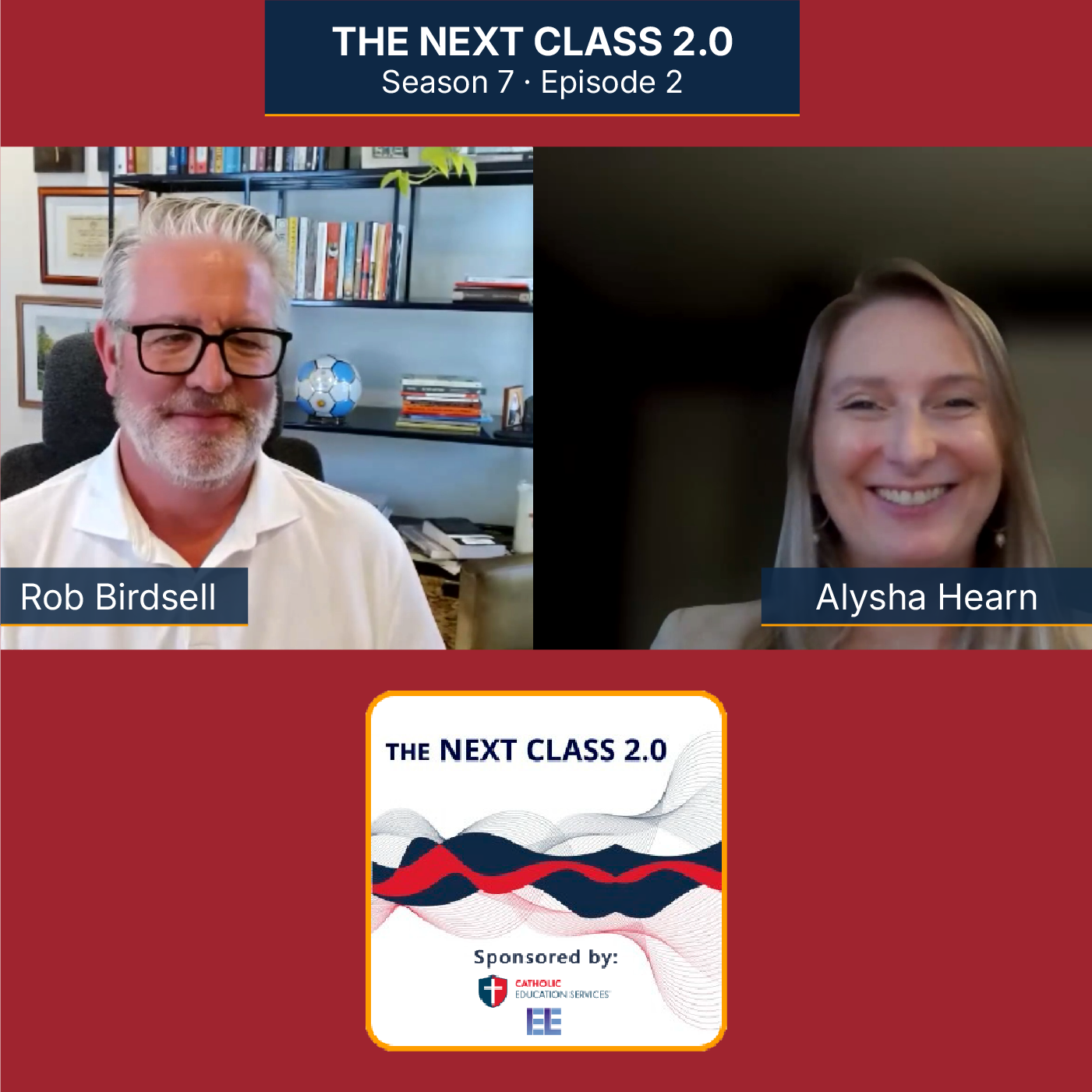
Explore higher education trends, college readiness, AI, internships, and university pathways with Rob Birdsell and Alysha Hearn on The Next Class 2.0.
Watch this Episode
Listen to this Episode
Stay Connected
Enjoying The Next Class 2.0?
Get new episodes delivered directly to your inbox.
About this Episode
Higher education is evolving rapidly, creating new challenges and opportunities for Catholic schools. In this episode of The Next Class 2.0, Alysha Hearn of Hudson Global Scholars joins Rob Birdsell to discuss college readiness, career-connected learning, AP and dual-credit pathways, university partnerships, AI, and the skills students need to thrive.
Tune in and gain practical insights to strengthen academic opportunities, support college affordability, and help students stand out in an increasingly competitive future.
Key Takeaways
- The Changing Higher Education Landscape: Understand how demographic shifts, enrollment challenges, and increasing competition are reshaping universities and creating new opportunities for students.
- College Readiness Beyond Admissions: Discover why internships, career services, industry connections, and professional networking are becoming essential considerations when choosing a university.
- AP vs. Dual Credit Courses: Explore the advantages of both academic pathways and why the best choice depends on each student's learning style, interests, and college goals.
- Expanding Academic Opportunities: Learn how Catholic schools can strengthen their college preparatory offerings through online courses, advanced coursework, and educational partnerships.
- University Partnerships and Pathways: Understand how partnerships between high schools and universities can create opportunities for college credit, scholarships, and more accessible routes to higher education, specifically the HGS College Pathway Certificate and Preferred College Admission Program, offering priority consideration for admission to their partner universities, a simplified college application process and scholarship opportunities.
- Artificial Intelligence and Future-Ready Skills: Examine why school-wide AI policies and skills such as creativity, critical thinking, communication, and collaboration are increasingly important.
- College Affordability and Value: Explore evolving tuition models, financial transparency, and the importance of evaluating a university's financial stability and career outcomes.
- Personalized Learning and Student Choice: Discover why giving students more opportunities to pursue their individual passions and academic interests is one of the most impactful ways schools can improve college readiness.
Transcript
Rob Birdsell: Hello and welcome, everyone. I am Rob Birdsell. This is a fun, unique event. It's going to be a webinar, as you're all expecting, but we're also going to do this as a podcast, so we'll be recording this as Next Class 2.0. Which is in its 7th season, I think? Maybe 8th season? And, so we'll be releasing this, and your questions will… will be included in the podcast, so… Fire them off, and happy to, to pause and jump into your questions as you have them, but Very excited to welcome Alysha Hearn to the next class, 2.0. Alysha, welcome.
Alysha Hearn: Yeah, so happy to be here. Great to be talking to you, Rob.
Rob Birdsell: Yes, if it's anything like our, sort of, conversation before this, this is going to be free-wielding and all over the place. But for our listeners who don't know you, can you just share a little bit about your background and what you do now? Before we frame this conversation.
Alysha Hearn: Absolutely. So I'm the Vice President of University Partnerships at Hudson Global Scholars, and I oversee our advising team, and we assist our high school students getting into international universities all over the world. So I have the pleasure of talking to university leaders. Both in the US and in other countries as well, and really staying on top of the global trends. seeing what's going on and how it's affecting our students and our high schools and our partners. And it's all very interconnected.
Rob Birdsell: That's great. Well, again, welcome to the next class. So, to begin, could you share with us what you see? I mean, you're dealing with universities all the time. It's a… very challenging time for higher ed, the past few years, for a lot of obvious reasons, but could you share what you're seeing? Our listeners are generally going to be high school administrators and leaders. And so they don't get on campus as much as you do, or they don't get to talk to university people. What do you see as the state of higher education today?
Alysha Hearn: Well, I think the word you used, challenging, I hear that a lot. I think that's a great way to describe what the state of higher ed is. But on the other hand, I like to look at it with a positive viewpoint. I think this is also… anytime there's a lot of change, there's also a lot of opportunity. And right now, you see universities that have always done things the same way. Suddenly there's a huge amount of innovation, there's more partnerships than ever before, people are moving faster, people are being really responsive to what students want and their demands because they're not taking students for granted anymore. They know that there's more competition than ever before, so they're working harder to get people's attention and to provide the sort of services that people really want.
Rob Birdsell: Yes, that's… that's… I think my experience too, so good description of where we're at. You know, one of the things that you describe as more demand. I've read that for the top 30 universities in America, it is harder to get into than ever. more applicants. I have a friend who is at Fairfield University. They're… they're… They've got 35,000 applications, you know, from.
Alysha Hearn: Yeah, it's amazing.
Rob Birdsell: 5 or 10 years ago, it's… so the top schools seem to be doing great. But we are in the middle of a demographic cliff. What does that mean for universities and for our high school leaders? What should they be aware of when we think about the demographic cliff that is here literally right now? So what is it, and what should a high school leader be aware of?
Alysha Hearn: Yeah, I mean, you said it like the. The top schools, the most selective schools, are getting even more selective, and smaller liberal arts schools, regional universities, they are… really, I'm not going to say struggling, but they're working much harder. To get those… get the attention of those students. The demographic cliff is here right now. it's peaked, and now it's going down, and we're expecting, like, 13% decline in the next, you know, 10 years, 15 years, and so it really will be affecting schools so much more. With top universities, like, even schools That maybe aren't Ivy's. some schools are getting a lot more attention, like even Northeastern. Northeastern University, used to be a regional university, but they have really done a great job of really maximizing their co-op program, because that's something a lot of students are looking for right now. They want to have insurance that they will be able to get jobs afterwards, and Northeastern's done a great job of presenting themselves as a global leader, connected to industries connected to, universities in other parts of the country. Their acceptance rate is at 6% right now, which is very close to Ivy's. It's insane. That's… it's really insane. But there's… for students who say… they see those stats, and they're like, there's no schools for me. I'm never gonna get into a school. That's absolutely false, because there's so many schools out there that have great educational options, and would be happy to have them. But often the schools that are in the news. Those are the ones. that have the much lower acceptance rates and are a little tougher to get into.
Rob Birdsell: Right. And for our listeners that are interested in this part of the subject, we did a podcast. about a year ago with Peter Stokes, who heads Huron Consulting's higher ed practice, and really interesting discussion about the closing of colleges, and I still, again. I'm not great with data and numbers, but I still remember this fact that was astonishing to me. Of the three or 400 universities that have closed in the past 10 years. 50% of those students just dropped out. Like, they didn't re-enroll anywhere else. And of the 50% who re-enrolled at another university. 25% of them did not complete.
Alysha Hearn: Okay.
Rob Birdsell: So a significant number of these students attending university don't finish. I mean, that's. 60, 70, 80% of the students at colleges that close don't finish, and do finish with debt, unfortunately. And we talked, for our listeners that want to go back to it, about what high school leaders should be teaching their families, their students to be looking for. Things like, look at the… ask for the 5-year enrollment data. If a school's declining for 5 years in a row, that might be a warning sign this would not be a good fit for your student. Ask for their 5-year debt rating. You know, these, these… Questions that you can ask as a parent, as a teacher, as a president, as a principal, to steer your students to a school that will be there not only for 4 years, but for years to come. to build on the alumni network. But let's come back to your comment about internships. How…
Alysha Hearn: Well, just to add on to that really quickly, also endowment and tuition, because schools that only depend on tuition to function. They're the ones that are really fighting for those students, and if they don't hit the right number of students, then that's when all the layoffs happen, that's when they start dropping majors, and when you see schools, and this has been something that's happening a lot too, is, like, mathematics, philosophy. Theater, like, all of these… Majors that used to be considered. status quo, schools are shaving them off. And a lot of those happen with those universities that are dependent more on tuition than anything else for operating costs. But sorry, back to…
Rob Birdsell: No, no, that's a great question.
Alysha Hearn: So.
Rob Birdsell: Another question. What is your endowment? What's you know?
Alysha Hearn: What is.
Rob Birdsell: Is its growth, you know, what is its tenure record? Internships, yeah, let's come back to internships. Talk a little bit more. I, Obviously, through Cristo Rey, I have a lot of experience with students. in internships, and the value is incredible. I mean, Chris Duray often says that secret academic sauce is the internship. But when I was in college, I didn't… I didn't know anybody doing internships, so tell me what the prevalence, what a school leader should be aware of with internships. Would love to have you go a little bit deeper in that.
Alysha Hearn: I think it's essential now because people, when families are looking to pay a lot of money, there's so many questions about whether to even invest in college right now because the prices are high. People are questioning higher ed. And there's a lot of… uncertainty with AI. Like, are students going to be prepared for the future when they graduate? So when universities do a great job of building in internships, making sure their career center is very strong, very active, then they're going to really win those students. over. And, you know, my example of Northeastern, Northeastern is completely winning right now because the internships are the core of their brand. And they've really expanded that. It went from kind of a regional, more, like, technical school to now it's, like, global powerhouse. So I, I think the more that, Schools can really beef up their marketing as well for making those industry partnerships, you know, whether it's with whatever… businesses are surrounding their college and making those connections, or elsewhere. And can actually show that they can place students in these places, they're gonna get way more attention, because parents are gonna trust that, and kids are gonna trust that too.
Rob Birdsell: Just on a personal experience, my youngest daughter is a senior at the University of Minnesota, and she has an internship this year. 8 hours a week between the athletic department and Huntington Bank Stadium, their football stadium. And she doesn't want to stay in Minneapolis. as much as we love it there, she wants to come back to Chicago, and I was kind of like, well, how's this helping? The connections they're making for her in Chicago are incredible, because they're…
Alysha Hearn: Hmm.
Rob Birdsell: She likes what she's doing. She likes this position. And so they know people in Chicago that do the same thing. And so, not only is the work valuable of the internship, but the networking and connections. You know, the social network. of the internship is critical. And So Leaders look… look for universities that have internships. What should every school leader be doing to help prepare for the new state of higher education at their school?
Alysha Hearn: Well, I could go on and on about this for a while, too, Rob. I think just in… the big question is, like, how best to prepare the students, right? Like, there's so much uncertainty ahead of us. I think there's a couple things to think about. One, when we're talking about competition. So. yes, there's more competition for maybe liberal arts colleges and regional universities, but there's way more competition for students ever before to try to get into those more selective universities. So making sure that they have opportunities, every opportunity they want to excel. A lot of schools only have, like, a very small selection of APs, or dual credit courses, but, like, by partnering with an organization like Catholic Education Services, then it allows the students to really be able to pursue their unique interests, and that's something that can set them apart. And something that not every other student can have, because if you… want to pursue art, and you're able to take AP Art History, and you're the only kid in your school that does that. That's unique. Because any of these schools, they… the first thing that they look at, beyond activities, beyond your test scores is what courses are they taking? Are they taking the most challenging course load? possible for them, and are they doing well in it? Are they really challenging themselves? So, that's definitely one thing that you can provide. The other thing that I feel pretty strongly about, for school leaders, which I think is, like, the most difficult thing to do, so I'd love to hear what you have to say about this, Rob, too, is have… A school-wide AI policy. Because there's so many schools I've talked to so many school leaders, I've talked to so many teachers, and it's one of the hardest things to get aligned on. So I think, like, when the school leader can be clear about where he or she stands, with the AI, and also is continually learning themselves, completely knowing that, like. You're never gonna learn at all. But trying to stay on top of it, that will help get your teachers, your staff, and your students all on board, too. I think that's really helpful. And exposure to online classes, because over 50% of all College students have to take online classes, and if students haven't had any exposure to that, it can be really overwhelming, because the set of skills you need to succeed in an online class are very different. Than being in an in-person class.
Rob Birdsell: No, that's a great one. The provost of Seattle University was on our podcast about a year and a half ago, and he… he made the statement that if you don't offer online courses, you cannot call yourself college prep anymore, because you've not prepared your students to succeed in college if they've never taken an online course. Because, as you said, 50% of courses in higher ed are online, or blended. So, yeah, that's a great one that, The Offering the online courses is essentially a requirement today to consider yourself college prep. You know, Alysha, let's take a brief break here and get a word from our sponsors. And when I say brief, to those of you that are live, that was really brief, because they insert a commercial, so when you… if you listen to this later, you'll see a commercial come in there for Catholic Education Services, which Is the leading online partner for Catholic schools across the country, and if you are looking for To offer online courses, Catholic Education Services would be a great place to start. I want to come back, though, to… you mentioned AP Art. AP's been around, we know it's rigor, we know it's quality. What's new is dual credit. For those that don't know dual credit, the difference between AP and dual credit, could you talk a little bit about dual credit versus AP, and your thoughts?
Alysha Hearn: Yeah, so so many people are like which one's better? I get that question all the time, like which one is the best thing? And my answer for that is which one is right for each individual student? times when they can both be really beneficial. Dual credit. Is great, because it's just like taking a course. And it's a college-level course. And you get high school credit for it, and you also get credit from a college. So that way, when you go to college, the majority of the time, of course, depending on what your major is, you know, if you take an AP Art course, it may or may not transfer to your business program. But generally. those credits that you earn in high school will transfer, so that could save you $5,000 or more sometimes, just by taking this class. So. I would say the benefits of dual credit. For students who… May have a hard time taking tests. Like, there are some students that have, like, a lot of test anxiety and really stress out about Taking a final exam, which the APs are definitely known for. Doing the dual credit, you can just take a course and then you are able to earn this college credit. that you can transfer. So, it's a huge, huge bonus for students. But APs are great because there's such a wide variety of them. I think the variety is really wonderful for them, and they're just recognized everywhere.
Rob Birdsell: Yeah, and as I said, AP's been around. It's recognized for its rigor.
Alysha Hearn: the.
Rob Birdsell: Credit is potentially more accessible for different types of courses. I liked your answer, Alysha, a lot, though, that it's… depends on the student. It doesn't have to be an either-or. I, I had lunch with a Catholic, high school president the other day. 80% of his seniors will finish with at least 3 college credits. between AP and dual credit, and he does both. He offers.
Alysha Hearn: Yeah.
Rob Birdsell: And through Catholic Education Services, smaller high schools can offer every AP course now. And it's not only college prep, but it's also a differentiator. That if you're competing against a charter school or public school down the street. that may have a more robust curriculum, because they've got more students and more funding. By partnering with Catholic Education Services, you can offer literally every AP course, or maybe we might… we said sometimes one or two come in and out, but virtually every. every AP course through an online partner. I would recommend that, that counselors or principals, when advising, are aware of The nuances of certain universities, we talked about Fairfield, we know they don't take dual credit or AP credit. And most of the high-end IVs, Harvard doesn't, MIT doesn't. So be aware that not every school takes this… these credit, but well over 90% do. So just in advising your students, I would… I would check with your… where your kids are going, mostly. We talked a little bit about it, but Pathways and partnerships. You, you mentioned that when you were talking about what can differentiate a school today to talk a little bit more about what, what that looks like, what, what you mean by a pathway or a partnership for schools.
Alysha Hearn: Yeah. So, for universities, those schools that, may have to work a little harder to meet their enrollment goals. The sorts of initiatives that I've been seeing, and I say opportunities because I really think that some very, very cool. initiatives have come out of these efforts. Number one. the partnerships, as I mentioned, with industry. So, seeing more schools make partnerships with businesses and let their students have internships. Number two. Partners with other education institutions, like 3 plus 1 programs, or 3 plus 2 programs, and what I mean by that. is there's a lot of schools that maybe they don't offer, like a liberal arts school, maybe they don't offer master's degrees, so maybe they'll partner with another local college. that's nearby that does, and so you can do, like, 3 years at one smaller school, and then the final year at another one, and students can earn a bachelor's degree plus a master's in 4 or 5 years. Or a liberal arts school that, doesn't offer engineering. So… they can do 3 years at the liberal arts school, plus 2 years at a larger university, and graduate with an engineering degree. So, I'm seeing a lot more of that, both domestically, but also internationally. There's a lot of international schools that are doing 3 plus 1 programs. Plus doing more study abroad. Domestic schools are also partnering with international schools to really expand those offerings as well. And then finally with. The third type of partnership would be colleges and high schools. Our partnering to kind of create very simple channels. So that way it's streamlined admission. students know that they have a place to go, and it's great marketing for the high school, and it also works very well for the college, because they know that they're partnered with an institution that they have very aligned values with. And… Catholic Education Services is a perfect example for that, because students that will go to Catholic Academy, have streamlined admission to four different Catholic, U.S. universities, and also, this is something that we just launched this year. all of the international schools for Hudson Global Scholars, we also are opening the doors for any of the Catholic Academy students to be able to study internationally as well. And we have many, many universities all around the world. Japan, France, England, Canada, and that can give students a lot of opportunities, to study in some pretty top-tier schools, sometimes for only 3 years instead of a 4-year degree. Or. Lower tuition.
Rob Birdsell: Yeah, I know Canada, for example, I have a friend who's an administrator at the University of Waterloo. He runs the Catholic College at Waterloo, and the tuition is remarkable how much.
Alysha Hearn: Yeah.
Rob Birdsell: lower it is, and it's… it's a top 100, Waterloo and UBC, the other coast, University of British Columbia, another gorgeous school that is basically half the price of an American university. you know, I'm gonna pause you for a minute to remind people, if you have questions for Alysha, please put them in the chat. We'll be going to questions soon. Well, thank you for that, Pathways and Partnerships. That is also… it's not that unique, but it's smart for a leader, because you look at Jesuit high schools and Jesuit universities, they've had these pathways for You know, hundreds of years, and so it's…
Alysha Hearn: Yeah.
Rob Birdsell: A concept that's been around for a long time, but all schools should be thinking about. creating pathways for their students. You talked about AI earlier and having a policy. But what, I think about creativity, critical thinking. Catholic education is sort of at the crux of good Catholic liberal arts education. What are your thoughts on AI and creativity and critical thinking?
Alysha Hearn: I think those we I've been to so many different education conferences and I try to listen to as many of the leaders in the field as possible because everybody's trying to predict what students will need. Nobody really knows exactly, right? Nobody really knows exactly what the jobs are gonna look like, or. what things will be the… yeah, what job market will look like in 5 years from now, or 10 years. But the skills that I'm hearing, both out of the tech industry and the education industry. Is creativity, problem solving, critical thinking, because First of all, the critical thinking, like, you have to be able to differentiate between what's real and what's not real. You have to be able to, with the creativity, use the tools that are already there and really make something new. And the communication skills to be able to advocate and to be able to communicate your thoughts. So those very, very human skills. Plus, of course, empathy and basic skills such as like reading, you know, writing. Those are really important for communication, even if you have all the AI tools to help you with that.
Rob Birdsell: I like where that's going, Alysha, because I, Again, my kids are older, but when they would come home with an assignment to, like. memorize every state capital. I'm like, this is before AI, but I'm like, Google, like, why… why should you waste time memorizing every state capital? Why not give them an assignment to choose a state capital, and why was it named that, and how would you have made it differently? That is a much better assignment that, you know, AI is going to have some challenges with because That's the creative, critical thinking that you want to be developing in them, not the memorization that, you know, a computer can do in seconds. Well, the.
Alysha Hearn: Creativity, but also the collaboration. I think collaboration is super key. And this is something for school leaders too, because I think school leaders need to be more creative than ever before because all the rules have changed. Like we have to think of different ways to teach writing. We have to think of different ways to teach reading. We have to think about different ways. to get kids to work together, and the collaboration, like working with other school leaders. I mean, the school leaders who are here today, this is a form of collaboration. It's sharing ideas, it's bringing people together, and that is so important for getting ahead for students, too.
Rob Birdsell: I love that as a former English teacher that the Blue Books had their biggest sales.
Alysha Hearn: that.
Rob Birdsell: Ever, last year.
Alysha Hearn: gosh.
Rob Birdsell: They broke their record in sales. I'm not surprised.
Alysha Hearn: Surprise.
Rob Birdsell: Yeah, which is great, like, although.
Alysha Hearn: Okay.
Rob Birdsell: As again, a former English teacher, reading those was very challenging. Well, Alysha, thank you for joining the next class. This has been a wonderful conversation and a great resource for school leaders across the country. We're gonna end with one final question that we ask every guest over the past eight years who's come on the next class, and that is who is your favorite teacher and why?
Alysha Hearn: What a great question. You know, I have so many favorite teachers, but I would probably have to say Ms. Turnbull. She was… an English teacher of mine. And the reason I loved her so much is because I felt like she really saw me. And saw what inspired me, and she knew I was really into nature, I was really into reading and writing, so she even created a whole class just for me on, like, nature literature. And it was like an honors class. I went to a private school so she could be a little more creative and like creating classes. And when my friends and I wanted to. Drive across country when we were 18. She helped us plan our trip. So. She's definitely… deserves all the praise. All the inspiration and praise.
Rob Birdsell: That's great. Was Andy Dillard part of that course?
Alysha Hearn: Probably. I… I think so, yes. It was a long time ago, Rob. This was many, many years… this wasn't last year.
Rob Birdsell: That sounds great. Sounds like a wonderful teacher. I like what you said at the beginning, that she met you where you were and she saw you for who you were. that's… the best pedagogy out there is to meet the student where they are and build the trust so that they trust you. And.
Alysha Hearn: Everybody wants to be seen.
Rob Birdsell: Yes, no, that's beautiful. Well, Alysha, thank you again for joining us at the next class. To our live listeners, it was fun having some of you live. And for those that are watching the more traditional podcast, we hope you have a great rest of your day. And yeah. We did just get a question in before we close it out here. So Alysha, what we we have at least one question. If a Catholic school could make only one change this year. because we are in the middle of the year, but it's early. But if they can make one change this year to improve college readiness. What would you recommend?
Alysha Hearn: My favorite word is options. I'm all about options, giving students options, because just like I said, my favorite teacher saw me. and helped me pursue my personal interests. I think it's being able to give students The options they want to be able to pursue the education that they're passionate about, and that will help them prepare them for the future better than anything else.
Rob Birdsell: That's a great segue into Ryan Hunt. Ryan, welcome to the next class. 2.0. I don't think you've been on the podcast before. Can you mention… can you mention the four universities again that… Yep. So, just walk us through, if a student is at… say, Catholic Memorial High School. And they take a course with Catholic Education Services. They have access to the pathways. And those are great universities. I've been on the St. Edwards campus, it's in Austin, Texas, very hot community right now, literally hot, but it's also a popular community. And, if they take two courses with us, they get a 3.0. at almost all of these universities, they then get a… what did you say, a $20,000 or $30,000 scholarship? Which is pretty exciting for a school leader to think, you don't have to do any work. Alysha was describing one thing that you should be doing to differentiate yourself. Well, Ryan's got a solution for you, so that's pretty cool, and we, we do have a question here before I let you totally close this out, Ryan. Is… Alysha, is there still an income premium? With rising tuition, do students still perceive the value of a college degree? I'll let you take that one.
Alysha Hearn: Yeah, so it's interesting. There's been some shifts this year. A couple things. A lot of, I would say, low to moderate income families like can sometimes look at the prices of some schools and be intimidated by them. But in actuality, what you're going to be paying is going to be far less. And they've kept the prices high because they want to make it show like it's… it's a value. But schools are changing. Like, Beloit College this year, for example. They used to price it out probably closer to, like, $40,000 to $50,000. Now they're saying. $30,000 across the board. This is everything you're gonna pay. Transparency is getting bigger. Uvm, Vermont. They just, started advertising that everybody in New England is going to get an $18,000 scholarship. So, there's way more transparency, families are sick of not knowing at the beginning what they're gonna get… what they're gonna pay, and the tide is turning. So this is really good news for families.
Rob Birdsell: And what about students? perceiving the value of a college degree? Is that… do you see that changing? I know there's chatter about that, but…
Alysha Hearn: For sure, I mean, there's definitely, like, a lot more programs available for the trades, and also for high schools, too. There's more There's way more programs available than people are getting pushed in that direction because there are jobs that need to be filled. That being said, there's still value. And what colleges need to do to hold on to that is really demonstrate it that students will be able to be employed afterwards, and they'll be able to get those jobs that they want to go.
Rob Birdsell: And I think, I think it's a balance of that, because yes, you do need the skills and the training to get a job, but The purpose of higher education, the purpose of education, is to develop the mind and the person, and that's where I think Catholic education really thrives in developing, you know. I remember my first year at Marquette University High School, the president said to the parents on a welcome back, if you. If your goal is to get your child into Harvard, you chose the wrong school. If your goal is to get them into heaven, you chose the right one. And so, you know, for Catholic education, there's more than just the skills, and that's where I think. We thrive and differentiate ourselves. So, thank you for the questions, great questions, and thank you for joining us, either live or listening to us, where you listen to podcasts. If you enjoyed this, share this podcast with your family, friends, colleagues, like us, and we will turn it to Nancy to close us out.
Stay Connected
Never Miss an Episode
Get the latest episodes, insights, and education resources delivered directly to your inbox.
- New podcast episodes
- Exclusive education insights
- No spam. Unsubscribe anytime.