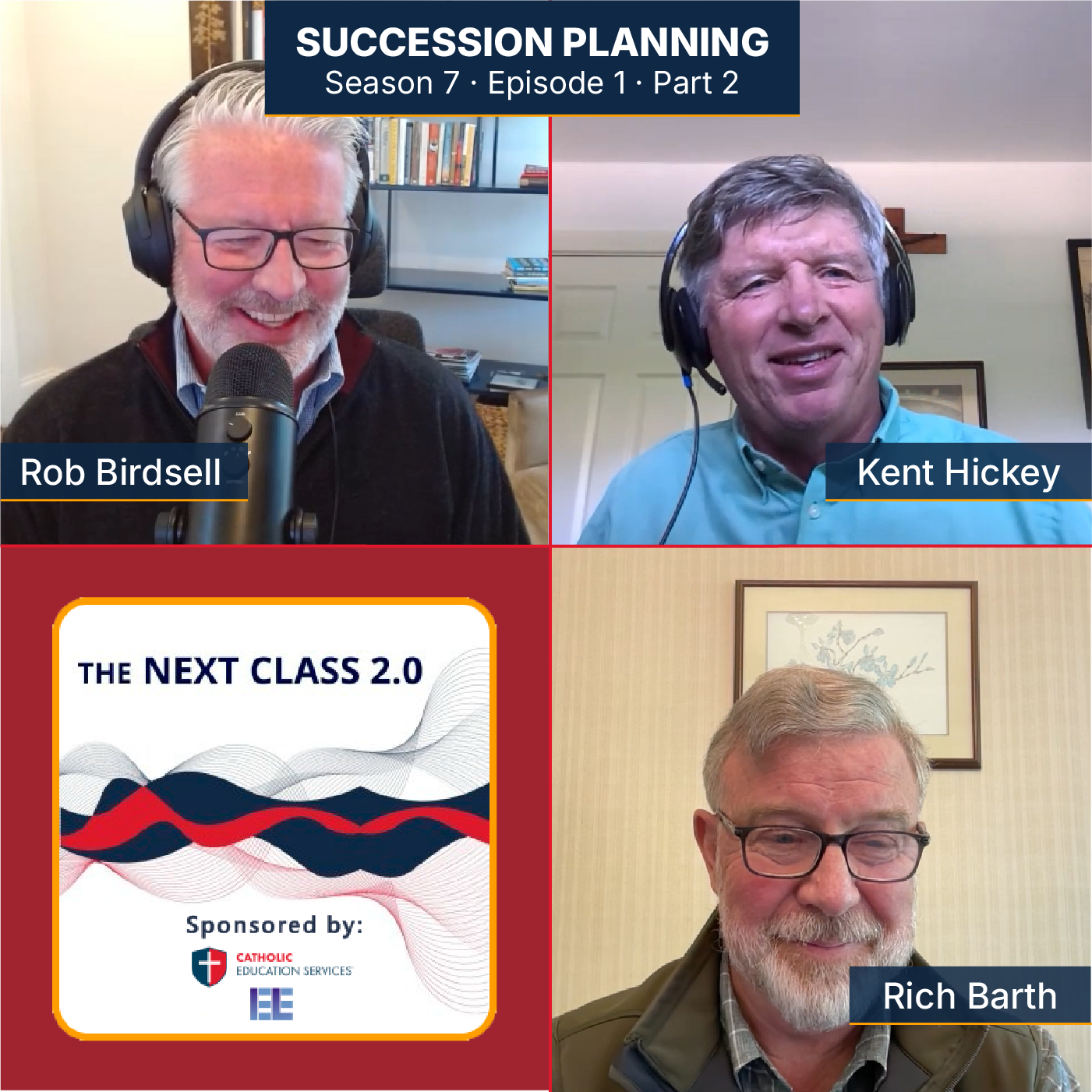
Succession Planning (Part 1)
Discover why succession planning is vital for Catholic schools as education leaders discuss stewardship, leadership development, governance, and building sustainable school communities.
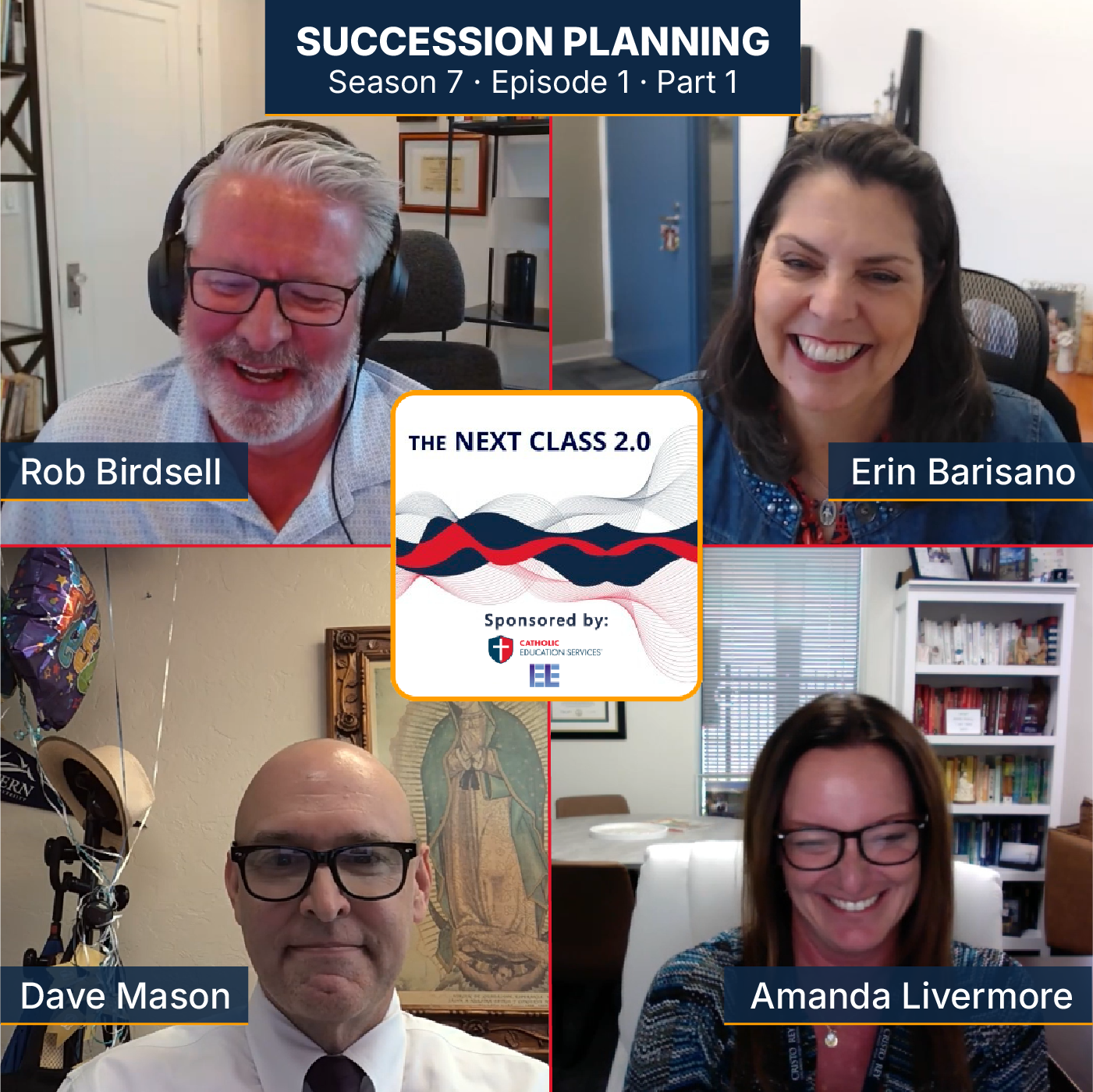
Watch this Episode
Listen to this Episode
Stay Connected
Enjoying The Next Class 2.0?
Get new episodes delivered directly to your inbox.
About this Episode
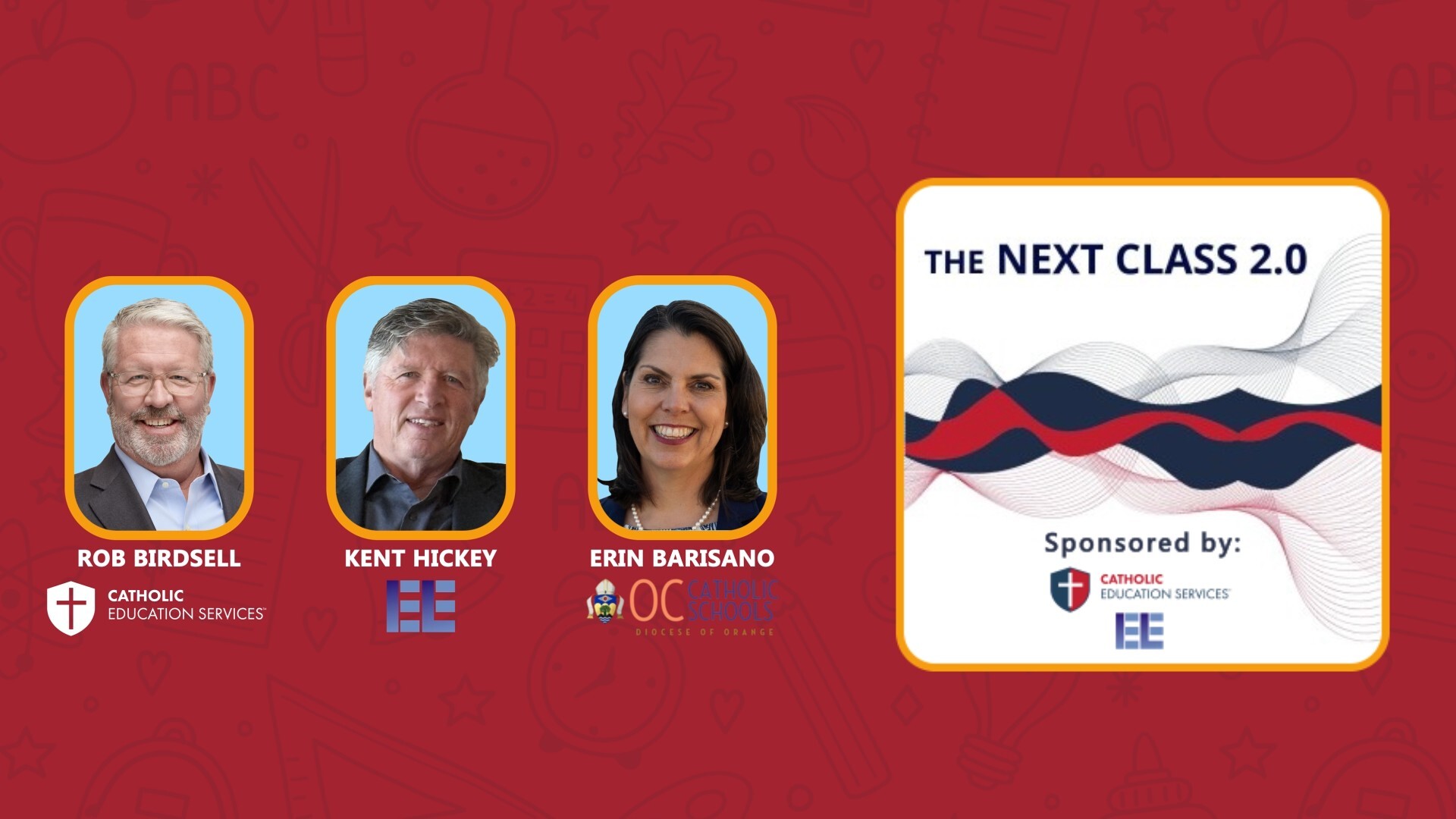
In Part 1 of Succession Planning, hosts Rob Birdsell and Dr. Erin Barisano welcome Amanda Livermore, Founding President of Cristo Rey Orlando, and Dave Mason, President of San Miguel Cristo Rey Tucson, to discuss why succession planning is vital to the long-term health of Catholic schools.
The discussion highlights how Catholic schools prepare future leaders, document succession plans, and invest in leadership development across all levels.
Rooted in Catholic leadership principles, the discussion underscores that succession planning safeguards mission over position. Through examples of both smooth and challenging transitions, the panel demonstrates how intentional planning builds trust, minimizes disruption, and sustains thriving Catholic schools for generations.
Continue the conversation in Part 2, where governance expert Rich Barth breaks down the framework and Catholic principles behind these real-world stories.
Key Takeaways
- Succession planning should be viewed as an act of stewardship, not as preparing for someone's departure.
- Clear governance roles help prevent confusion during leadership transitions.
- Emergency succession plans should be documented, reviewed regularly, and approved by the board.
- Leadership development should occur continuously, not only when a vacancy arises.
- Investing in current leadership teams creates a stronger pipeline of future school leaders.
- Poorly managed leadership transitions can have lasting effects on staff morale, community trust, and organizational stability.
- Catholic leadership is rooted in mission, humility, and service rather than personal achievement.
- Strong relationships and open communication between presidents, boards, and leadership teams are essential for successful succession planning.
- Jesus' example of preparing future leaders provides a model for succession planning within Catholic education.
- Every Catholic school should begin succession planning with honest conversations between the school president, board leadership, and leadership team.
Transcript
Announcer: Welcome to The Next Class 2.0 with host Rob Birdsell, Kent Hickey, and Erin Barisano. Join us as we discuss the latest trends and innovations shaping education.
Rob Birdsell: Hello and welcome to The Next Class. I'm Rob Birdsell, your co-host, joined as I frequently am by Dr. Erin Barisano. Erin, how are you today?
Erin Barisano: I'm great, Rob. Always good to be with you.
Rob Birdsell: And to be with you, and we're actually going to be together in a couple weeks in person, which will be fun.
Erin Barisano: Yeah. Yeah, that'll that'll be great work.
Rob Birdsell: So, let me introduce our guest today. First, Amanda Livermore is the founding president of Cristo Rey Orlando. Amanda, do you want to tell a little bit about your school?
Amanda Livermore: Sure. We are really excited to be wrapping up our very first year with our founding freshman and have just been blown away by their incredible growth and success over this year, and are really looking forward to welcoming our next freshman class. So, we will have freshman and sophomores here shortly.
Rob Birdsell: That's exciting. And how many freshmen did you have?
Amanda Livermore: we opened with 121, and we'll be at about 130 coming in next year's freshman class.
Erin Barisano: Wow.
Rob Birdsell: Holy cow. So, you'll be 250.
Erin Barisano: Oh, that's awesome.
Rob Birdsell: That's that's amazing, Amanda. great, successful start. Our other guest, Dave Mason, a long-time colleague and friend of mine. Dave was on the founding team at Cristo Rey Twin Cities. He then joined me at the Cristo Rey Network for a few years before heading out to Tucson, where his current position is president of San Miguel Cristo Rey in Tucson. Dave, tell us a bit about your school.
Dave Mason: Thanks, Rob. San Miguel, Cristo Rey here in Tucson is actually a little over 20 years old now. we we just This is our 21st year. One of the original 10 Cristo Rey schools, the only school in Arizona, and we're one of three Cristo Rey schools sponsored by the De La Salle Christian Brothers.
Rob Birdsell: And what's your enrollment at at San Miguel?
Dave Mason: We are almost exactly at 300. And Amanda, you've got us beat. We're looking at about 95 freshmen this year coming in. but we're really excited. it's actually up a little bit from the last couple years, so we're we're excited.
Rob Birdsell: That's great. and the Brothers are great partners, I know, of yours. so for our listeners, the subject today that we're going to dig into is succession planning, specifically in a Catholic school. and some of the framework that we'll be discussing we heard in our prior podcast with Rich Barth and Kent Hickey. Rich wrote an incredible white paper that will be in our show notes. it's also on Catholic Education Service's website and on ileeconnect.org, our website. so if you are wanting to see it and you can't get it in the show notes, those would be two places for you to go get it. and so let's jump into it. In Rich's framework, he draws a clear line of who owns what—the idea of subsidiarity in our church. and he makes it pretty clear, and I I do think it's one of the best papers I've read on succession planning. But the president owns staff succession. The board earns owns presidential succession. The governance committee owns board succession. In each of your experiences, how often are those lines actually respected? And, Erin, you can jump into this, too, because you you see a lot of this.
Erin Barisano: .
Rob Birdsell: So, Amanda, let's start with you.
Amanda Livermore: All right. I think the lines get blurred a lot. Succession planning seems to be one of those things that often people are either afraid to talk about or don't think about talking about until there's an urgent situation. And then, when there's an urgent situation, people can get involved in ways that might be outside of, what's appropriate for their role. And so, that's been very important to us as a first-year school; we've actually built this is very intentionally right from the beginning. So, those roles are clear, and succession planning is just a part of what it means to build a school and a succession plan. but that way, the board knows their part and the the, me as the president, I know my part. But also, that our whole founding staff understands that this is a part of, being on a growing, living, breathing team is that we are all part of the succession planning for Cristo Rey Orlando.
Rob Birdsell: That is great. Dave, in a very different situation, a 21-year-old school. succession planning there. And you've also been there, is this your 12th year?
Dave Mason: I'm finishing my 10th year as president here. so yeah, really good points made by Amanda, and I would say that the Brothers, and I think, Rob, I've talked with you a little bit about this, that that the Brothers all of the schools in the District of San Francisco New Orleans, which is a huge district, follow a policy governance model required by the governing board, the Lasallian Education Commission, which is the umbrella board that oversees all the local boards. And, we have this detailed policy governance handbook—or I should say, our board of trustees does. And it really is specific in terms of roles and responsibilities. That that policy handbook, which is several pages long, speaks very, very specifically to those lanes or those roles that you just mentioned, Rob, in terms of the role of the board, the role of the president, and does a really good job of making sure that everybody stays in those lanes, but also that everybody's very aware of how important the topic is. And I think it really gets to that point of, I think, in the white paper, they talk about stewardship. It's really a matter of stewarding the mission beyond any one chief administrator.
Rob Birdsell: Yep.
Erin Barisano: That's right.
Rob Birdsell: And, Erin, a diocesan perspective?
Erin Barisano: Yeah, no, I think I love the way that you ended, Dave, that idea of stewardship. I think I just brought that whole conversation, right? We don't often think about succession planning that, because the work that we do as school leaders is so personal, and so it becomes very much of our work, right? And sometimes, often times, we need to remember this is not our work, right? This is God's work. We have been placed here at this time, in this place to carry out the work of God, this greater mission. And so, so that whole framing up of succession is just really, really caught my eye. I know it's something that we're always working on at the diocesan level. And I agree with you, Amanda, those times that you find yourself in these times of crisis and, hair on fire and trying to figure out what next, who's next. And that's when people start overstepping those boundaries, right? Because we're problem solvers. We want to solve problems. Yeah, and that's there's a problem to be solved, but yeah, that stewardship piece, I think, is such a vital part of that that that whole view of succession planning.
Rob Birdsell: And sticking with you, Erin, for another moment here. For diocesan schools, the bishop holds the canonical authority over key appointments, unlike Dave described the brothers, and Amanda, your sponsor is an order of Sisters of blanking.
Amanda Livermore: That's right, the Servants of the Pierced Hearts of Jesus and Mary. and then we are governed by our board, and they sit on our board.
Rob Birdsell: Right, so the private schools, if you will, that is, the canonical authority is the order. In in your schools, almost all, not all, but most of your schools, the bishop owns that. How do you build a board at your schools that genuinely prepares for transition while respecting that the final call may not be may not be yours as a board member?
Erin Barisano: Right. Well, I think, and one of the the missing pieces of this white paper, it is brilliant, but the missing piece is superintendent. I wrote a wrote a note in there, that where's the superintendent? because the superintendent is the designee of the bishop, in, for Catholic education in the diocese. And, and it's always, it's all built on relationships, right, and that trust. And so, carrying out the wishes and the vision of of the bishop and ensuring that that that that that message is consistent. I think always, always, always leading with mission and vision, and just being consistent in that with our boards, with our boards are advisory in nature. They're not governance because these are diocesan schools. but again, that that clear understanding of what the mission of the diocese is, what the mission of this particular school is, how there's perfect alignment with the mission and vision of what our bishop is, and it's it's that clarity, it's that consistency, and that accessibility, so that when questions arise, we can talk stuff through. We can always, always talk stuff through. So that just goes down again to that relationship and trust building.
Rob Birdsell: That's a good transition to our second theme here, which is relationship, not isolation. And relationships are a core tenant of ILEE, and we believe that so much education is relationships. so, Erin, I'll let you take us into the second bucket here, relationships.
Erin Barisano: Yes, yes, and I love Oh, my gosh. There is so much in this white paper that I loved in this idea of communion, right, of being in communion with one another, and that relationship. It's It's a very It's very Catholic, and that leadership operates in relationship, not in isolation. So, the framework's first question asks: If the president were unable to serve tomorrow, who would act immediately? so my question to you is, can either of you answer that right now and, more importantly, is it that written down? Has that been formalized?
Dave Mason: I'm I'm happy to start on that one, and to answer the question, Erin, it it is and it It is in our policy governance handbook, and it actually I found the policy here in our handbook, and it says It's Executive Limitation 11, Emergency Succession, and it says, I'll read it if it's okay. it says, "In order to protect the board from sudden loss of CEO services, including the continued reliability of critical revenue streams, the CEO shall not, number one, omit having two other school administrators who are familiar with the board and CEO issues and processes to enable either of them to take over with reasonable proficiency as an interim successor, or, two, operate without creating opportunities to develop potential successors for administrative positions at the school as well as achieving this through participation in the San Francisco New Orleans District Discerning Leaders Program." So, I present this policy in the form of a monitoring report usually at the August board meeting, and the board votes on whether or not to accept my succession plan, and currently I'm pleased to share that I do, I have Brother Matthew is a current member of ILEE, he just started. He is one of the two that have gone through the Discerning Leaders Program and are prepared to do this work. and then also my Vice President of Advancement, Ricardo Dominguez, would be the other. so, I'm in compliance with that policy at the moment. but I think it speaks to the point of the brothers being way ahead in this area and really hold me accountable as the acting CEO to have this ready each and every August at that meeting.
Erin Barisano: That's really good leadership. Having that's so formalized and, again, just really, really important for everybody understands it, there's clarity there, and there's thoughtfulness for the good of the organization. Yeah, thanks. Thanks for sharing that. Amanda, any thoughts on that one?
Amanda Livermore: Yeah, in addition, and I Dave, I appreciate you sharing that, and may want to build some of that language into some things that we do, so I'll ask you to share that with me outside of this call as well. but we've also written down, because when you're talking about relationships, it's important that we're looking at, who the people are on our teams and really diving into what are the core competencies that it takes, . As the president, I can sit right now and know these are these are the things that, with that I can discuss with the board that I believe are non-negotiables for the success of this organization, so that if something happens to me tomorrow or as a long-term plan, this is, ultimately, the core of this mission and the leadership of this mission at this time. And here are some of the things that I see that could, especially as the school scales and grows, might be gifts that I don't have that a next leader could have that could really take the school where it needs to go next. And so, we have a document written as well where, in addition to pointing out some of those pieces, I've also laid out all of the members of our leadership team and both at the VP level and at the director level, and for my for my board to know, who is on the team and what their areas of strength are, what where I see them in a position of how close are they to being ready for the next step in their own professional progression, and what are some of the development pieces that I'd, encourage and that I'm going to invest in in the next year for each of them to help move them to that next level. So, it's not just succession planning specifically for my role today as CEO and president, but also, for that whole leadership team. And ultimately, the next president might be on that team. So then, what do they need? What are the gaps currently that could potentially prepare them for for this role?
Erin Barisano: Wow, I am so impressed with everything that you all just shared. And, and I feel like I have a lot of work ahead of me with particularly with my diocesan high schools, we're nowhere near what you're what you're what you're sharing. And, and again, just I just I can't shake that from my head, that that stewardship. Like, it's just really It's not only smart business, but as as people of faith, as ministers, this is this is what we are called to do as stewards of these resources that have been entrusted to us. So, so thank you. I may be calling you after this to to share some of those tips. so, let's talk you're so well planned with all of this, but have either of you in your careers lived through an unplanned transition? And, what actually happened, during that, what do you wish had been in place?
Dave Mason: Well, I have Oh, sorry the announcement there. Oh, my goodness.
Erin Barisano: Ah, you're a school site, that's okay.
Dave Mason: When I took this role, and I don't know if if Rob knows this or not, that a midyear, so I guess it would have been end of 2015, early 2016, the the school where I ultimately took took the role, CEO San Miguel, was without a president and a principal.
Erin Barisano: Wow.
Dave Mason: and the I won't get into the details of the of the transition. We had an interim president who ultimately hired me, someone that you and I know pretty well, Rob, Matt Powell,
Rob Birdsell: Yep.
Dave Mason: was the interim president here. and I knew that coming in, if I did ultimately get the position, and it was part of my discernment process, that I knew that there was going to be a faculty and staff and larger, broader community that was dealing with some trauma, and a lot of fallout, as we all know, when these are these leadership roles have unplanned transitions, the the stakes for the school are really high, and the subsequent fallout from those unplanned transitions extends sometimes months and maybe even years into the new the new president's
Erin Barisano: Yes.
Dave Mason: role when they come in. And I knew that coming in, and having a great interim president that could help bridge that gap and fill me in and help in my transition helped a lot. But I would say that it's very, very difficult for many, many reasons to that point, and so when we talk about stewardship, you as a board of trustees never want to see that happen, because it takes a while to dig out of that situation. and you want a school to be clicking on all cylinders, and you don't ever want to deal with that.
Amanda Livermore: And there's so much personal for the for the staff, for the community that's attached to all of that, and in setting up the next leader for success, the people behind the scenes that are really working through a process or not, Dave, you just you defined too what I have seen and lived through in some experiences with transitions that you it really can impact morale, it can impact trust in, the mission, the organization, from supporters, from current staff members, from, the students that we serve. And, the communication around when someone leaves, especially if it's unplanned or at least seems, can appear to be unplanned, how important the language is that we use, that we're constantly, really respecting and focusing on the dignity of the human person in every aspect of that and how people leave, and and how we share that news and how we celebrate the great work that they did, and how we welcome somebody new into that work. So, I've lived through also on on a leadership team when a leader transitioned out of a school and it was not managed well, and it can leave a lot of insecurity. And then, what really happens is so much energy gets spent on everybody speculating and the conversations that are happening and all of that, and it really distracts from the mission, which are, the students that we're called to serve, and leaves a lot of instability. And, and as Dave said, can be can be years. And even if a great leader comes in, they're really coming in, with, some big challenges in addition to the challenge that is already education, Catholic education, that we're working on. So.
Rob Birdsell: Great. Well, thank you both. We're going to take a short break here to hear a word from our sponsor.
Announcer: The Next Class 2.0 is proudly sponsored by Catholic Education Services and ILEE—two organizations committed to supporting Catholic schools and their leaders.
Catholic Education Services, formerly Catholic Virtual, partners with Catholic schools to deliver online education services, including expanding course offerings, filling teacher openings, and creating alternative learning options. Learn more at catholiceducationservices.com.
ILEE, the Institute for Leadership and Entrepreneurship in Education, offers Catholic school leaders a unique professional community for spiritual formation, leadership development, and renewal. Discover more at ileeconnect.org. That's i-l-e-e-c-o-n-n-e-c-t.org.
Together, we're helping Catholic schools thrive today and lead with vision for tomorrow.
Rob Birdsell: And our break is over. we've been talking a lot about stewardship, discernment, which I think was one of the grounding themes of Rich's white paper, and something that I had not really thought about, and I found it just really interesting. And in the process and the spiritual core of what we're talking about here, and planning for your own succession can feel disloyal, even pessimistic. How have you personally worked through that discomfort or the awkwardness of planning for the day you're not there?
Amanda Livermore: I think we're invited to a holy detachment when it comes to that, that this work is not ours. and I say to the to my team and the students every day I'm walking in under the name of Christ the King, this is his school, it's not mine. and really believing that, praying, praying with that, also looking at Jesus, who himself was an incredible leader, and is still, an incredible leader for us, but he did this. His He had a succession plan. His leadership was multiplicative, . He said, "Okay, I'm forming you so you can go out, and at some point, I'm going to not be here, and you need to keep doing this and do more than I did." And so, to lead from that space of not only, will there be a time that I'm not going to be in this seat, but it's going to be because someone who can do better things than I can at that stage in Cristo Rey's history will come in. And that's really exciting and good, and not awkward. and so for us, talking about that from the beginning, talking about that we have a leadership model here that that restores and multiplies, that doesn't control, and that this is really mission—the school is mission success, not charismatic success based on Amanda Livermore or based on any other individual person, but it really is the success of the school is because the mission is well lived out and the people, the people who are here collectively have really seen that that's true, . So, a lot of focus on that and transparent conversations all along the way.
Rob Birdsell: Amanda, that is beautiful hearing you say that. And Dave will know this, but in the early years of Cristo Rey, I didn’t get that sense from some of the founders, that there was a lot of their ego tied up in the launching of this new school, and the early founders looking back were very charismatic. One I'm thinking of, he would have people in tears literally in two or three minutes. And Dave probably knows who I'm talking about. He's not with us anymore, God rest his soul, an amazing human being. But I'm wondering, and Dave, maybe for you, looking back, do you see that, and having done the work with you guys at the Cristo Rey retreat, the presidents today seem very humble and less about the big ego. And I'm wondering if that was when you were starting something 20 years ago and there wasn't there weren't 40 other schools, you had to be this big personality, whereas today, it's proven. there are 40, soon to be 41, of you. And, Dave, any thoughts on that?
Dave Mason: Yeah, I I think, and I I'd love, to hear Amanda's thoughts as well, coming in, being one of the newer presidents serving in this role. I feel like now, probably more than ever, and maybe it's a byproduct of the size of the network now, there are so many leaders now in our network that that I feel like there's something greater than even our own local ministries now, that we see that the sustainability of this mission, in fact, not just sustainability, but incredible growth over the years, and there's a sense of comfort in that, I think, whereas, early on in in some of the startup years, you're right, Rob, I'm thinking of a number of different people that were larger than life people that willed these schools and that into existence, and those people, I think even their boards probably would say, "What would happen if this person wasn't here? Would the school go on?" And I think it's very different now in terms of thinking about the young talent that are on our teams, Amanda spoke to that, and the and the tremendous potential of leaders in our schools that are discerning whether they want to take the baton at some point.
Rob Birdsell: Yeah, no, it's really interesting. And, Amanda, any thoughts on on this subject of the big, charismatic founder versus the humbler—
Amanda Livermore: Well, yeah, I'll just say to Dave's point, the reason Cristo Rey opened with the success that we did is because I and my board members visited more than 30 of the 40 schools, and my team members, and we learned from every single one of them. And I saw different styles of leadership, success at every one of those Cristo Rey schools in a a way that was so unique to that community and that charism, and yet there were things that were true about the mission that were true across the board, whether, regardless of, the different communities that had come together to build that school. And so, that I think for us really started us off also on a foot of humility of saying there's so there's so many people doing this work, and this work is hard. This is easily the hardest thing I've ever done, and I feel like I've done some hard things.
Erin Barisano: [Laughter]
Amanda Livermore: And then that we come together when we come together on retreat with you, Rob, and as an example, we are all very vulnerable to each other in that. There's really no posturing or, just only sharing the good stuff, and we need that, too, because as as Dave said, to sustain, this is Its big work, it's heavy work, and I I really appreciated the posture of humility that the other presidents brought to the table, and that certainly set the tone for us.
Rob Birdsell: Yeah, it's amazing. Well, thank you for that. I'll turn to Erin for our final theme here. Erin.
Erin Barisano: Yeah, I love, Amanda, I love that term "holy detachment." Gosh, that's really, really powerful. I'm going to use that if I may. And also, we just like you said, we need to go back to Christ. And He modeled this. He modeled this succession planning, so just some pearls of wisdom right there. But for you have, gosh, both of you just some great advice and really great things in actually in practice, but for those Catholic school leaders who are listening right now and and don't have any of this, don't have anything written down, what would you give as just a practical bit of advice, that that one thing that they should do this week in terms of this succession planning?
Dave Mason: I think it would probably start with a conversation between the school president and the board chair, and if it's if it's not just the board chair, I think, the executive committee of the board is the perfect place to say, whether or not you're looking at years left in your tenure as president or, a year or two, whatever it is, regardless, I think having that conversation in terms of in the framework of stewardship, which we've come back to now multiple times in this podcast, that it really, are we doing the best we can to steward this mission, and it's a together. It's a board working in concert with the CEO and the religious sponsor as well, I think, is also really, really important. So, those that would probably be my initial thought.
Erin Barisano: Thank you. Amanda, anything to add to that?
Amanda Livermore: Yeah, I, agree with Dave, and then as a as a second step, I would say, a similar conversation with your leadership team, really talking about, what their growth goals are, where they see opportunities and gaps in their own, leadership practices, and if they have a desire to be, I think, sometimes we make assumptions about people, and, that can hurt the morale when they're they felt skipped over when an opportunity was available and no one ever had a conversation with them. So, talking with the leadership team, that succession planning at every level, they should be doing it on their teams as well, but really looking at the gifts and talents and their desires for the future, and then that's better information to bring back to the board in those conversations.
Erin Barisano: And then, of course, praying about it. Just get face first in front of the altar and just say, "This is not mine."
Erin Barisano: Amen. All right, great. Thank you.
Rob Birdsell: So, final before we get to our final question, but finish this, a fun one, finish the sentence: "A Catholic school without a succession plan is like . . ."
Dave Mason: A lifeboat without oars.
Erin Barisano: Mm. Good.
Amanda Livermore: a house built on shifting sand.
Erin Barisano: Ah, good. Very good images that I think are really good, yeah.
Amanda Livermore: I was going to go boating. I was going to go boat, and then—
Dave Mason: You were too slow; Dave took it.
Amanda Livermore: I know.
Rob Birdsell: Well, I I thought it'd be good to sit on an image as Erin alluded to there, a lot of Catholic schools that don't have a plan. Yeah. And, let's get the oars and make sure the firm ground that you're building your school on is ready to take this transition. But, we finish every Next Class podcast with a final question that we ask all of our guests, and that is: Who is your favorite teacher and why?
Rob Birdsell: Wow, we've—
Amanda Livermore: All right. Well, mine was because I have so many, so let's be clear.
Erin Barisano: Hard to narrow it down, yeah.
Amanda Livermore: So, I had a teacher named Miss Suzanne, who I started with in third grade, and then, would work with through, elementary school. And I was the ADD kid before ADD was diagnosed, and most I think a lot of teachers had a hard time managing me. My board chair might say the same thing. You could ask him.
Amanda Livermore: But she saw something in me and recognized just found ways. Before there were all of these resources available, she found ways to help me really tap into my own gifts and talents. And it shifted me from always getting into mischief to actually really being able to use that for, creative good and, dreaming big and, just making things happen. And so, I'm really grateful to her.
Rob Birdsell: Beautiful. And Dave?
Dave Mason: Yeah, I was in the same boat, Amanda. There's like so many, to try to narrow it down, but I guess I must go with a high school science teacher named Mr. Keemly, and he looked like Einstein. he was the caricature of, lab coat, I never ever saw him, he always had the lab coat, I think he wore it at home, it was his normal, the frizzy white hair. But he was my biology teacher in high school, and then he also taught some specialty elective courses. But I did well in bio, and he encouraged me to go on and take his botany class, which was one of those elective classes, and I didn't really ever even consider or think about it until he encouraged me to do it. And I think it really encouraged me in later years to try and, do do take classes and try things outside of your comfort zone. And then later, when I taught for many years, I I always really did the same thing, and it was really all because of him and push kids to try new things, and see where maybe they had talents that they never thought they had. So, yeah, God bless Mr. Keemly.
Rob Birdsell: Beautiful. Well, thank you both, for joining us today, some some great, practical, and, and wise, advice for school leaders and board chairs. so thank you for your time, and it all began on a on a bus coming down from Lone Rock. Kent overheard you two talking, and he's like, "This is amazing! We got to get this out there!" So, thank you to Kent, thinking of this. And, we look forward to seeing both of you soon. And to our listeners, if you enjoyed this conversation, share this podcast with your family and friends, like it wherever you are listening. So, and a shout-out to Carlos, our producer, in the background. Thank you for putting all this together. Erin, always great to be with you.
Erin Barisano: Yes, good to be with you, and thanks for the conversation.
Dave Mason: Thank you.
Amanda Livermore: Thank you.
Rob Birdsell: On that note, we will wrap it up here, and I will see you on The Next Class.
Announcer: Thank you for tuning in.
Stay Connected
Never Miss an Episode
Get the latest episodes, insights, and education resources delivered directly to your inbox.
- New podcast episodes
- Exclusive education insights
- No spam. Unsubscribe anytime.