
Succession Planning (Part 2)
Learn how Catholic school boards and leaders can build sustainable succession plans through stewardship, governance, trust, and intentional leadership development.
Watch this Episode
Listen to this Episode
Stay Connected
Enjoying The Next Class 2.0?
Get new episodes delivered directly to your inbox.
About this Episode
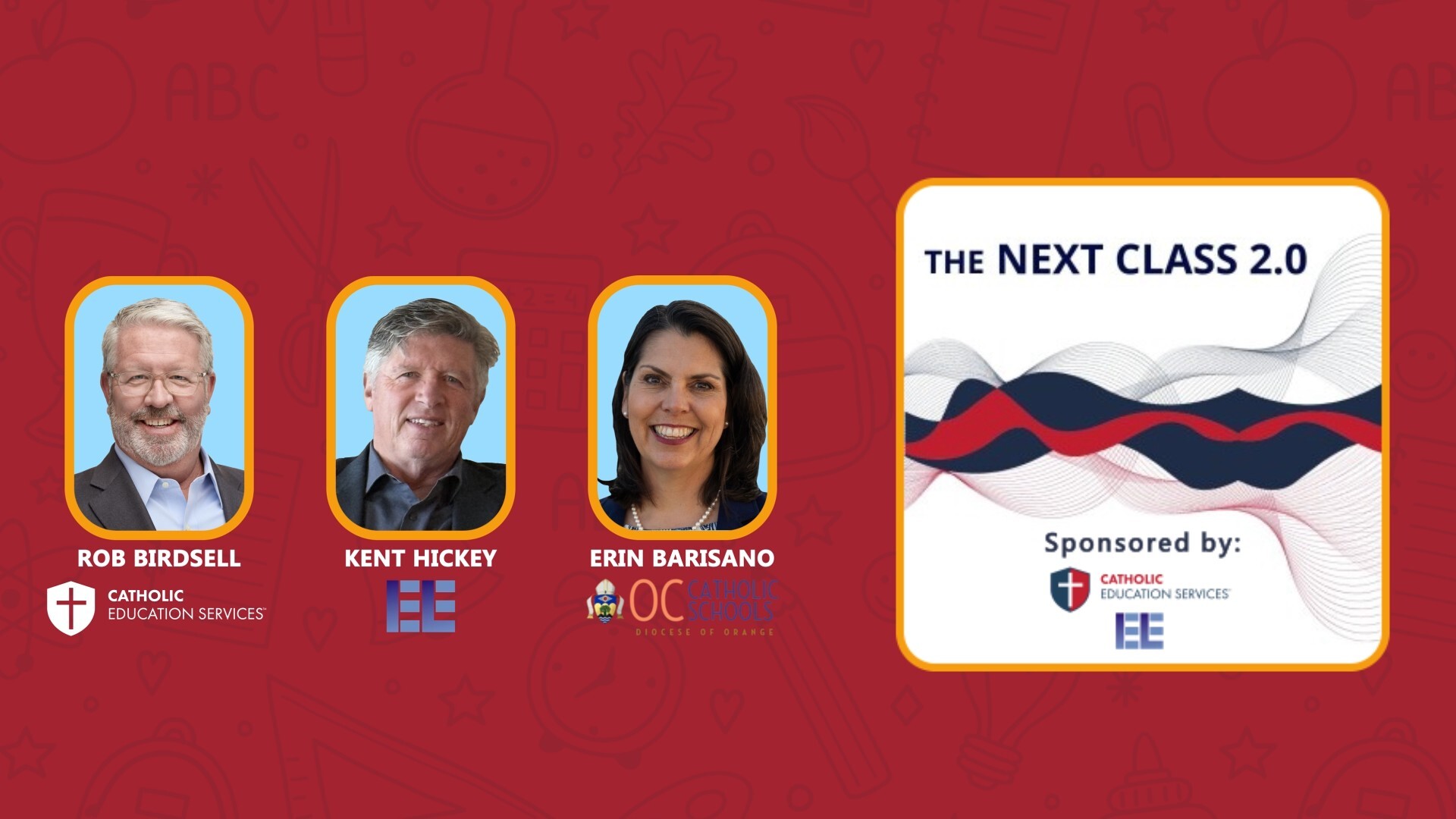
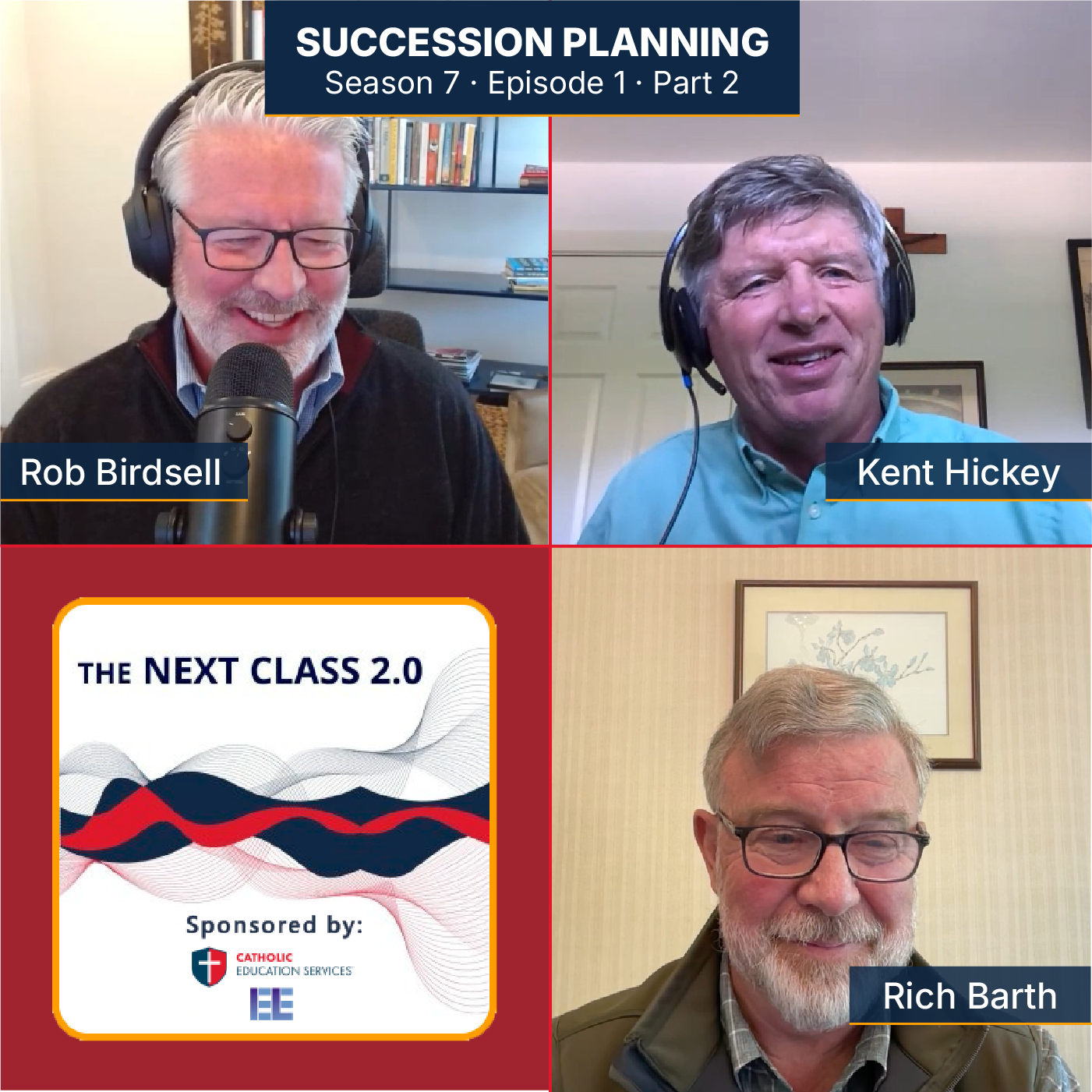
Building on the real-world stories from Succession Planning, Part 1, this conversation turns to the framework behind them. In Part 2, Rob Birdsell and Kent Hickey join governance expert Rich Barth to unpack how proactive succession planning strengthens Catholic school leadership and preserves mission continuity.
Drawing on experience across military, tech, nonprofit, and Catholic education, Rich shares practical strategies for boards and their presidents to define roles, build trust, and prepare future leaders long before transitions occur.
Listeners will gain actionable insights on stewardship-driven governance, communication, and leadership development—tools to help Catholic schools sustain strong, faithful leadership for generations.
Key Takeaways
- Leadership succession is an essential responsibility of Catholic school governance.
- Great leaders strengthen their institutions by preparing future leaders before transitions occur.
- Boards are responsible for presidential succession, while school presidents are responsible for developing their leadership teams.
- Trust and regular communication between board chairs and school leaders create stronger succession planning.
- Succession planning should be proactive rather than reactive, reducing uncertainty during leadership transitions.
- Transition periods, including interim or transitional leadership, can provide stability and prepare schools for long-term success.
- Catholic principles such as stewardship, subsidiarity, communion, and discernment provide a strong framework for governance decisions.
- Leadership authority is entrusted in service of the mission rather than personally owned.
- A practical annual succession planning checklist helps boards evaluate readiness and identify gaps before a crisis occurs.
- As Rich Barth summarizes, "Leadership in Catholic schools is temporary. The mission is not."
Transcript
Announcer: Welcome to The Next Class 2.0 with host Rob Birdsell, Kent Hickey, and Erin Barisano. Join us as we discuss the latest trends and innovations shaping education.
Rob Birdsell: Hello and welcome to The Next Class. I'm Rob Birdsell, your host, joined as I frequently am by Kent Hickey. Kent, good to see you.
Kent Hickey: Good to see you, Rob.
Rob Birdsell: And we have our guest, Rich, who has quite an interesting background here. Starting at the Naval Academy, MIT, the Air Force, and Microsoft. And now you're writing on Catholic school governance. How did—how did the path lead to that?
Rich Barth: Well, across the military, the technology, the nonprofit governance, I kept seeing the same reality: that important missions require intentional leadership. And over time, I came to believe that the first responsibility of leadership is actually developing the future leaders and ensuring that that institution is stronger when we leave it than when we found it. And that became especially meaningful to me in Catholic education, because the mission is—the mission matters enormously. Schools are not just educational institutions; they are literally helping form our young people, our families, and our communities into the next generation. So, if we believe that's important—and I do—then leadership can't simply be good enough. We have a responsibility to cultivate strong leaders, to prepare future leaders, and to ensure that mission continues long after we're gone. And all of that comes down to making sure that we have great governance and we develop great leaders.
Rob Birdsell: I couldn't agree more, Rich. And—and you led a succession process as the board chair at Seattle’s Nativity School. What was that experience like from the inside?
Rich Barth: It was a great experience, actually. The—and I’ll divide it into two pieces. The board succession, which is specifically the board chair succession—we already had a pretty good succession plan for the board itself. And then the president's succession. So, on the board chair succession, that was—both sides are really about communication. But the board chair, it was making sure that I communicated with—I talked individually to anybody on the board who I thought was qualified to replace me, talked about their qualifications, what—what their views were, their interest. And surprisingly, there were a number of people who were simply not interested in that role. And then at the appropriate time, I took it—the process to the board. So, after I had some sense of who was available and who was interested, then I disclosed to the whole board the whole process of interviewing. I was fortunate that there was only one person who was interested and well-qualified, so I didn't have to make any choices. But it's actually a strength if there were more than one person, because the board is the one who makes this decision; it's not the board chair. You just try and line up the tee so that it makes it easy for the board to have a succession. But it's the board’s responsibility; it's not yours.
On the presidential side, I would say that I was a little less successful in the sense that my belief is that the board chair and the president basically negotiate and work through—they are both together responsible for the succession plan for the president. And I think that the president should start that process. You want to listen to the president and hear who they think is probably the best qualified to replace them. In this particular case, we didn't make much progress on that. I, of course, had a backup plan if there was an emergency, but there was nothing to present to the board; we didn't have a final plan.
Rob Birdsell: Interesting. We—the second part of this podcast, we have two practitioners talking about succession planning, and one of them runs a Lasallian school, and they have a very deep succession planning process. And every August, he has to present to the board—the president presents to the board two candidates for their approval, that if he were incapacitated for some reason, that they've got two people ready to go. And it just seemed quite amazing to me that level of detail, and that the board has to approve them. If he presents two and they say no to one, he's got to come back next board meeting with another candidate. So they've always got two in waiting. Not that they're going to be a successor, but, if he gets hit by the proverbial bus, they got a plan, which I found—
Rich Barth: That's where I would have loved to get with Nativity.
Rob Birdsell: Yeah, no, it was pretty impressive. Kent, let's turn to you for a minute. You were the head of three schools and now you're president of a Catholic school system. What do you think is the role of the school head in succession planning as opposed to the board?
Kent Hickey: Yeah, thank you, Rob. I just mention something about Rich Barth here, because I just was thinking as he was talking what a great benefit it would be for every Catholic school board to have someone on the executive committee, even if it's not the chair, who thinks like Rich does. So, Rich is, deeply committed to Catholic education; he's a very caring man—and this would be a characteristic of board members overall, I would say—but he’s a systems thinker. And I think sometimes what ends up happening—and I'll move into your question here a little bit—is that there’s tension around even the discussion of succession planning, often, and because feelings can get involved.
I used to—when I used to practice law years ago, I used to do estate planning. And in this white paper, I really like the fact that Rich draws this comparison to estate planning. No one wants to do their will. And but the best time to do your will is when you don't need to do your will. As a matter of fact, it’s impossible to do your will when you can't do it anymore. The fact of the matter is that people in their 30s need to do their will. And if that doesn't happen, then when death does occur, people are asked to scramble, and they’re asked to do things at a very terrible time of grief. So I was really struck by his succession plan in that it focuses on: do it now. and it really removes feelings from it, because feelings shouldn't be involved.
But, and now I'll go directly to your question, Rob. When it’s brought up to a president, or there's a discussion around succession planning, sometimes the context can be very hard, okay? And that’s—leads to defensiveness and such for the school president. So, I think that the necessity of having the kind of plan that Rich talked about, or what the Lasallians did—you know, what you mentioned there, Rob—is absolutely essential so as much as possible the emotions are removed from it.
So when I started as a school head, it was actually in a previous century, alright? I love saying that; I've been told that, "Kent, you think that's kind of cool? It really isn't." But I think it's hilarious. But I'll tell you, back in '99 when I started, back in the day, presidents or principals—we never thought about succession planning. That wasn't our thing. So—so the answer to your question too is historically, in my mind, it's never been viewed as a responsibility or part of a partnership for the president or head of school to do that. That's for the superintendent in dioceses, or the board chair, or quite frankly, in provinces and religious orders. And I look back at that now and I think that’s absolutely wrong. That my sense throughout most of my time of a head of school was, well, that's not my thing. You know, that's succession planning for someone else. And it was exactly the wrong approach. And so, some—some of the best examples are negative examples, and that’s a negative example. And what these discussions with Rich have brought up to me, and looking at his paper, is like: no, this is—I got to think about this, or a school head has to think about this, exactly differently than what a lot of us have learned or thought over the years.
Rob Birdsell: Rich, coming back to you. The estate planning analogy—where did that come from? That was a really interesting one that Kent was just talking about in your white paper.
Rich Barth: That's a difficult one to actually answer. I—as I’ve been thinking hard about succession planning since I became chair four years ago. And I’m also at an age where I actually have to think about my estate planning. And it—I guess it was—it's very clear to me that they are the same problem. They have the same issues, right? Estate planning is not rocket science. But there's a lot of pieces and it's really hard. I’m an engineer in background and so I want everything to be complete. It's really difficult for me to take a small step and say, "Okay, let's just take the first step," and not know what the next step is going to be. But that's succession planning and that's estate planning.
Rob Birdsell: Yeah, interesting. And that is just such a good analogy, having recently done our first will at 56, not—it wasn't 30 when we did that.
Kent Hickey: Well, I just to follow—and I did probate too. And when there was not estate planning... ah, it was—it could be so hard, because so—personalities get involved, or there would be questions that, what were they thinking? This thing. I actually do think it's a perfect analogy for succession planning. It's a difficult discussion that has to be had and it’ll be better once it's had. So...
Rich Barth: And it really is not that hard. We just—something inside of us makes it difficult to take that first step.
Rob Birdsell: On that note, Rich, is there—is there a fear that taking or talking about succession feels disloyal to a successful leader, and how do you push past that?
Rich Barth: I have a couple flavors on that answer. One, actually Kent's comment about that he felt difficult in talking about that as the president surprised me a little bit, not just knowing Kent who can talk about anything. But I actually did not appreciate that might have been an issue for the—for my president in trying to go through the process that I did not find particularly successful in saying, "Please help me find your successor in case you need to do it."
I don't think of it—I don't think of it as disloyal. It's part of—in fact, I would—I would want the president, whose—not whose job it is not necessarily to tell the board, "Hey, I should have a succession plan," it's the board’s job to talk to the president. But I would want a president who has leadership excellence to say, "Oh, I better have a plan for when I’m gone because I love this institution and I want it to last." So I don't—I don't feel it's challenging from that side, though I do—I do hear the point that other people might.
The place where I think it might be most challenging is that the net definition of a succession plan is that you're making a choice. And while that choice is fairly closely held, I’m asking the president to choose somebody who's going to succeed them, or two people in the case of your Lasallians, which is a great, great plan. But you're still saying no to somebody, and they're going to find out you said no. So I think that there's a fair amount of challenge with that. And the bottom line comes down all the time to just communication and trust. We have to build trust across the board, and no institution can survive well without that trust.
Kent Hickey: That last comment, Rob, just to follow up on what Rich just said about trust. I’m not going to disclose anything here that I think is problematic, but I’ll just will mention that I remember a board chair having a discussion with me about succession planning. It was really, really good. And because there was a level of trust and communication and we were working in partnership, which is when a head of school and a board chair should be working in partnership with each other. And the primary—a primary role of the board is certainly to care—cura apostolica, to care for the apostolic work. But the cura personalis, the care for the individuals leading the school, is really, really important. That led to a really good, robust discussion for succession planning.
But I'll tell you what, I also had one of those where the board chair brought up to me succession planning—it was a hammer. It was: "So I need for you to sit down right now and tell me what your succession plan is for this year and da-da-da." And there was none of that pastoral part; there was none of that real discussion. It was cold, it was harsh, it was extremely difficult. And, yeah, so I’ll just admit it, some—when that—when it's approached that way to me, I’m going to be more defensive. I feel like I’m playing defense. Like now we’re in a negotiation, this thing. And so I think that yes, it is up to the president to be more humble and to be open to these discussions, to understand it’s about the institution, it's not about the person. But it’s also really helpful to have a board chair that has communication skills and—and has built trust, that there's a trusting relationship between the two. And fortunately for me, most of my time, and work—and I'll say right now, I’m in another role as a transitional president—gosh, I really like this board chair I’m working with. There’s already established a level of trust and such. So that relationship is key that will lead to those really robust discussions.
Rob Birdsell: So, let’s—there are a lot of schools that don't have a succession plan. What—what's the worst-case scenario if all of a sudden they need one and they don't have one?
Rich Barth: The most common failure isn’t a dramatic failure of the school, right? Schools—succession happens without a plan a lot of times. But if the board doesn't know—if the board doesn't know who should lead temporarily, the board becomes anxious, the staff becomes anxious, donors start asking questions. The institution just doesn't perform at peak performance. And again, going back to the leadership and back to the whole mission of why we're doing this, we really have to be performing at peak leadership. So it's not going to be a great crisis probably; on the other hand, there's a small percentage of cases where it is a great crisis.
Rob Birdsell: Right, right. Let's take a brief pause and hear a word from our sponsor.
Announcer: The Next Class 2.0 is proudly sponsored by Catholic Education Services and ILEE—two organizations committed to supporting Catholic schools and their leaders.
Catholic Education Services, formerly Catholic Virtual, partners with Catholic schools to deliver online education services, including expanding course offerings, filling teacher openings, and creating alternative learning options. Learn more at catholiceducationservices.com.
ILEE, the Institute for Leadership and Entrepreneurship in Education, offers Catholic school leaders a unique professional community for spiritual formation, leadership development, and renewal. Discover more at ileeconnect.org. That's i-l-e-e-c-o-n-n-e-c-t.org.
Together, we're helping Catholic schools thrive today and lead with vision for tomorrow.
Rob Birdsell: And we're back here. Kent, you spent some time at Carney Sandoe & Associates, an executive search firm. What did you learn about succession planning during your time with Carney Sandoe?
Kent Hickey: Well, it relates actually to the comments that Rich just made. So usually, the need for a new school head is not something that's planned. There could be any number of reasons for this. Here's what I learned: is that I think we should be much more open to including in the planning the interim's role or, in my case, I’m now doing it for a second time, something called transitional president. As not a bad thing—oftentimes, by the way, that comes about due to a failed search. So if an interim comes in, it's right off the heels of a word "failure," okay? And it doesn't inspire the community and then—such.
But the fact of the matter is, particularly for schools that have had long-running leaders, or I would say leaders that have had a religious in the role and they move to a lay person, there's a number of situations where I think the succession plan should actually intentionally include a year of transition or perhaps two years of transition as an interim or—or some kind of title in that regard.
So for example, the role that I’m playing right now in Fresno schools: they moved to a really good system whereby they have four schools, none of them big enough to have a president. Each has a principal, and there's a president that’s running the system so to speak. Well, I’m transitional president. They’ve already determined who their next president will be. And she’s wonderful; she has the role of vice president. And we’re going to be working together this next year, and then she’ll step into the role as full-time president.
So just as you said, Rich, when these eruptions happen or people don't know what's going on, the community is impacted by that. They want to know who the leader is or is there a plan. So I think the succession planning isn't just about who's going to take over, but what is that—you know, that interim period? Is it just going to be waiting in a dental office waiting room, or are things going to actually happen to move us forward a little bit? So I'd say that's what I learned at Carney Sandoe is that I really think that schools should start embracing the notion that having an interim or having a transition—that could be a really good part of the plan itself, and it’s not just reactionary; it's building toward something.
Rob Birdsell: Interesting. Rich, in your framework, which our listeners can get on our ILEE website, ileeconnect.org, and also Catholic Education Services’ website will be posted there if you want to download it. But your framework clearly divides presidential succession from staff succession. Presidential succession being the board’s job, staff succession being the president's job. Walk us through that and what happens when those lines blur.
Rich Barth: Well, as Kent and I have had long discussions, I believe very strongly in responsibility at the appropriate level, at the lowest level possible. And recognition that—we’ve had discussions on other board issues where the board poaches into the president's business. The staff belongs to the president. The president hires the staff. The board—it's nice, it's a really good idea for the president to keep the board informed of that, but it's the president's responsibility. And it's the board’s responsibility to hire the president and manage the president. And so succession planning follows the same path to me. It's straightforward. The board has no business in interfering with the president's succession for the staff reporting to the president. The board does own the president succession, though as I said, a good board is going to ask the president to give them a presentation because the president is closer to the candidates and knows what's going on. Does that answer your question?
Rob Birdsell: Yeah, yeah. No, that’s—I just hadn't seen it so clearly laid out as you write in your framework. That it's, as you said earlier, it's not rocket science, but the way you lay it out in your framework I think is just very clear and concise.
Kent Hickey: Could I just mention that? so this white paper that you mentioned, Rob, to download in a couple places—I really would encourage every school and every board to download it. Because it's just an—I’m not going to make Rich blush a little bit here, but—because it's such a—it's so clear. It’s just so clear and so helpful. And it’s—you might see something like, "try your best," or "Be nice." Well, yeah, okay, those things are really important. But I need a little meat on the bone. And this has meat on the bone. And if it's a starting point for a great discussion and people can just borrow from whatever—I think it's the best piece I've ever seen written about succession planning. And I just hope that Catholic schools will embrace it. I wish I’d seen this years ago, actually. Why didn't you give this to me years ago, Rich?
Rob Birdsell: Part two of this podcast, both of the school leaders had read it and agreed. They were—they found it invaluable. But Rich, going to diocesan schools: the bishop holds real authority over appointments. And actually religious orders—generally the member above the board has to approve of a presidential appointment. And how—in these situations, how do you counsel boards to plan proactively within that structure rather than around it?
Rich Barth: I think the key is what you just said: proactive. You have to establish trust with the bishop or with the member board above you. And trust is not generated if the only time they see you is during a crisis. So you have to spend your time reaching out to the bishop and his staff and talking to them in the normal—at normal times. Now, realistically, we know bishops have a lot of things to worry about and your school is probably—you hope—is not the highest one on his list. But the establishing—if the only time he hears about you is when it's time for a succession and he's—why would he trust whatever you say? So it's pretty straightforward, in my opinion, that you have to spend some time reaching out to the bishop, especially his staff. In Seattle, we have a Catholic Schools Board, and so talking to the chair of the Catholic Schools Board and making sure that relationship continues is just part of doing business. And it's the same for any business that you work in. If you're in a commercial business, working with your clients is something that you do. Does that answer your question? I feel like that was a weak answer.
Rob Birdsell: No, no, I think the proactivity is the key. I know of an annual meeting with the bishop’s team.
Kent Hickey: If the bishop will—again, the superintendent plays that role a lot, but it’s consultative, in that regard. And it's—I never, I guess over the years, I never heard once a complaint, for example, from parents saying, "You guys communicate too much." It's really the opposite that's most there. And what ends up happening—and I think actually this is one of the problems during the pandemic, is that one of the issues during the pandemic was the lack of communication that would often happen in, the silo-ing. We’ve written about this before: the board chair and the president should be having coffee once a month. And not to talk about "Here’s what blew up," but just the regular stuff, because then trust is established. And also I’d say it’s clarification of roles. I had a board chair once—most board chairs are—who really insisted on her telling me that she’s my boss. Well, actually the board is my boss. The board chair represents that. And right away, if that’s the dynamic that’s established, it’s going to be difficult, going forward. So the more—and I’m not saying conversations will cure that, but it will help that. "Hey, I have a different perspective," this thing. Just constant ongoing discussions.
In terms of that changeover, by the way, when the board—and I’m really—I think I’ve been pretty good about this anyway—is when that new person is being hired, it's super awkward, by the way, as the school head to step back. I remember this at Bishop Blanchet, when I was at Bishop Blanchet and—and you kind of want to be involved because, you know, it's the school you’ve been working at and this kind of thing. You're involved if you're invited. And that’s just in a consultative role. And actually some of the best things you can do is stay out. And we see this at a lot of schools where a person, particularly if they’ve been there a long time, will kind of show up at things that probably shouldn't. So it's really up for the president to practice detachment in that situation and say, "Yeah, you gotta pull back." And that could be hard to do.
Rich Barth: To close the loop on succession planning: that is a topic that I think you should be talking to the superintendent of your school board and your bishop before the case. So you establish that trust that says, you—the bishop—get to make the decision. We’re not questioning your decision-making, we're just telling you that, "Hey, we’re planning, we're available, you can trust what we're saying. If you have a different decision, that's fine with us."
Rob Birdsell: Yeah. Rich, in your framework, one piece I really liked was that you rooted it in four Catholic principles: Stewardship, Subsidiarity, Communion, and Discernment. What does it mean in practice, from your experience, that authority is entrusted, not possessed?
Rich Barth: It follows directly from the conversation we just had, right? The bishop is entrusting you with the authority to run his school. And that is building up the trust, making sure you stay—continue to communicate both up and down, or across, however we decide our parents are. Making sure that they understand what's going on in your school, that you are leading properly, correctly, with excellence. Communicating excellence, I think, goes a long way towards making sure that you have been entrusted with authority. And acting like you own the authority is the first way to lose that trust.
Rob Birdsell: Interesting, yeah. We’re also just talking about discernment, and you explicitly named that in your paper. Not hesitation, but deliberate learning before acting. How do you build that into what can be a pressured transition moment?
Rich Barth: Well, again, the point of succession planning would be you don't want it to be a pressure-filled moment. And that's—if you're in a pressure-filled moment, I won't say it's too late to discern because you still have to discern, but maybe you spend a little less time on it because you don't have the time. I’m a big fan of—discernment is—is taking the time to gather the spirit. In the pure Jesuit tradition, of course, it's about allowing the Holy Spirit to lead you, and you can interpret that any way you want. But it's building up the process of understanding in yourself what you're being called for. And even in a transitional moment, in an emergency, you certainly need to pay attention to—you've been making observations for a long time. How do you act on those observations?
Rob Birdsell: Interesting. And around that transitional, Kent, you—you mentioned earlier you're in a—you're a transitional president. How is that different from an interim, and how might that benefit succession planning?
Kent Hickey: "Interim" feels like something you slapped on, the title because you had to. In lieu of having an orange cone sitting in the chair, we’re going to ask you to sit in the chair for the year just to, have someone there. And I think "transitional" shows purpose and intentionality, that there's a plan that's in place. And in both places that I did this—down in Bakersfield and now in Fresno—there was—in the one case, the plan was to move to the president-principal model, okay? And so the transition was there. In this particular case, it's continuing to move toward this system idea, which I do, by the way, think it's a great idea across the country. That when you have particularly mid-sized cities, not enough to have a president at each of the schools, but makes sense to have one to deal with a lot of the fundraising or financing, that stuff.
Yeah, I think it's really important, those terms "interim"—and I’m not saying interim's terrible, by the way, because it can be actually a very good robust way to be a president or a head of school. I just think what it often times communicates to the community is: we're doing a stop-gap because nothing else has worked, and we'll get—then we'll get going on this. "Transitional" indicates there's a plan. And of course, then what goes along with it—that there actually is a plan. It's not just a result of a failed search or anything like that.
More and more schools, when they—particularly if it's a long-term president who’s leaving—instead of launching into a search right away, I think it makes a lot more sense to say, "We’re not going to actually do the search right now. We're going to wait a year or so, going to do this transitional president for a year or two," because sometimes a community has to get used to the thought of there's someone—someone new coming in, as opposed to Father So-and-So who’s been there for 25 years or something.
There's a—won't say the school—but there's a gentleman who’s leaving his school as the head of school after 50—50 years at that school. Not—not head the whole time. But that’s a person that's deeply ingrained in the culture. When I was consulting with them, my suggestion was: I would not hire a president—a new president—right off the bat to take the reins after the guy that’s been in the school as part of 50 years. it's a legend, right, that you're doing. Take a little time to breathe, a year or two.
Rob Birdsell: It’s almost like you’re setting the person up for failure if you follow a legend as opposed to a transitional that is there for a year or two to work through the transition. Yeah, that makes a lot of sense.
You know, in the second part of this podcast, when we have the practitioners, the two of them really gravitated to your writings about stewardship and how this is—this is not their job, this is God's job, or it’s not their school, it’s God's school, it’s the Holy Spirit. And I was just really struck by their humility that is required to lead that stewardship, if you want to just comment on that word that you use in there quite a bit in your paper.
Rich Barth: We referenced it a little earlier, right, that a great president—a great leader is worried about the institution, not about themselves. And it's the board’s role to try and get the president to have a presidential succession plan, but a great president wants it as much as the board: a succession plan.
Rob Birdsell: Yeah, no, and—and in the early years of Cristo Rey, many of the founders were so charismatic and larger than life. there wasn't a playbook. They were—this was working because they—they muscled it through. And in that, so much of their identity got wrapped up in the school as opposed to today, where there are 41 Cristo Rey schools. And I was really struck by the humility of these two Cristo Rey presidents, that their ego was not tied into the school. they recognized this school was not their school, it was God's school. And that detachment I think is critical to this—this stewardship.
Kent Hickey: I really agree with what both of you are saying. It—I'll say it's really hard. And maybe this is speaking more for myself, but I also speak, I think, for a lot of the presidents is: there is a sense of ownership, engagement, attachment. And so yes, like in Ignatian spirituality, be detached from, but then also be fully engaged with. And I find it really hard to walk that tightrope. I love—do really love—the idea of stewardship. This—this is God's school, and such. But I'll just tell you, I just really struggle with that, ? Because you get so involved in it, ? And this is—you get pumped up about your school and where we going and this thing. And then—and then it's like—and now not. So for person—the personalities I think that lend themselves to really good presidents—some of the personalities anyway—also are the same characteristics that make it difficult when you're talking about these types of things.
And so I think that’s a source of prayer. I think that's why we do our ILEE seminars and this kind of thing. And you know, I don't know which—which Pope it was. Was it John XXIII that said something like, "I’m going to bed now, God. It's yours." You know, and there's something to that. But there’s also the expectations from boards, the community are—are very much not that, you know? They want to be this full attachment and such. So really finding that balance is a hard thing to do. And I just say I struggle with it. It's a lot easier in the role I’m in right now. I know I’m there for a year, you know? So in this kind of—I’m a temp. It makes it easier, but—but it's a—it can be a really hard thing emotionally. I struggled with that.
Rob Birdsell: Interesting. And Rich, you talk about the annual checklist for a board. What’s on it and how does a board actually use it?
Rich Barth: It’s, hopefully, pretty straightforward. The idea is to go through the checklist and just—mark off—it’s to prompt you to ask the deep questions that you need to ask. It's not necessarily the "I could check every box." It's—it's a discussion that I would probably have with my executive committee and go through all of the pieces with my executive committee and then also with my president and say, "How do we address each of these topics?" The intent is that if you've addressed all the topics, you have a pretty comprehensive plan. And as we've discussed, getting a comprehensive plan is a really good idea, but you could start with just the first step.
Kent Hickey: That allows a—a really good conversation to happen without feelings. Let's say it’s a president and a board chair. And if they have a great relationship, it’s going to be easier; if they have a strained relationship, it’s going to be harder. But they're going to talk about this thing. And the thing is this checklist and this white paper. "Let's talk about that." It's a great entry point to have the discussion.
Rob Birdsell: Right. So to wrap this up, Rich, thank you. This has been a wonderful conversation. But if you could leave every Catholic school board chair with one sentence or one thought from your white paper and this podcast, what would it be?
Rich Barth: That leadership in Catholic schools is temporary. The mission is not. And great leaders ensure the mission continues.
Rob Birdsell: That was really fast. That was—that was outstanding. I like that. So, before we conclude, Rich, if you’ll indulge us, we ask every one of our guests on our podcast one final question, and that is: who is your greatest teacher and why?
Rich Barth: Wow. I finally got you. I’d like to say Kent because he told me—he taught me never to trust a school president, but... a guy named Ralph Santoro when I was at the Naval Academy. And he was the greatest teacher I've ever had because he had incredible, incredibly high standards that were not unrealistic, but he made sure that they were right at the edge of your capabilities and kept pushing you until you got there.
Rob Birdsell: Hmm. Interesting. That’s a good one. That's a great one. Well, Rich, thank you again. This has been an incredible conversation. And to our listeners again, you can download the white paper at ileeconnect.org or catholiceducationservices.com. And we are very appreciative of your insights that hopefully can be implemented at schools all across the country. And I love that final thought of: leaders are temporary, missions are not. That is a fantastic thought.
Gentlemen, thank you for your time. And to our listeners, we hope you enjoyed this podcast. If you did, please share it with friends and family, with other board chairs you might know, other members of your board. And until the next time, we wish you all a great afternoon, day, whenever you're listening to this. So, thank you very much, and we'll see you in the next class.
Announcer: Thank you for tuning in.
Stay Connected
Never Miss an Episode
Get the latest episodes, insights, and education resources delivered directly to your inbox.
- New podcast episodes
- Exclusive education insights
- No spam. Unsubscribe anytime.