

How Catholic Schools Can Support Elite Student-Athletes Without Sacrificing Academic Excellence
When Catholic school leaders think about student retention, elite student-athletes may not be the first group that comes to mind. Yet for many...
5 min read

Each year, Catholic Schools Week (CSW) offers Catholic school administrators a powerful opportunity to celebrate your community and reinforce your faith-filled mission.
There are more than 1.68 million students in 5,852 Catholic schools nationwide according to National Catholic Educational Association (NCEA) data. Your school’s story matters as part of this national story. This article provides practical tips and a checklist to help you tell this story in and beyond your community.
Catholic school leaders likely need no reminder about the value and impact of a Catholic education for students. In the 2024 NAEP assessments for grades 4 and 8, students in Catholic schools out‑scored their public‑school peers. Catholic schools have 99% high school graduation rates and 86% college attendance rates. Catholic schools are providing $24 billion in savings each year for the nation based on average public school per pupil cost.
Beyond data and metrics, a Catholic education forms the whole child—mind, heart, and spirit—fostering moral development, social responsibility, and a sense of purpose. Students learn how to live out faith in daily life, cultivate virtues, and develop a commitment to service and community. This holistic formation helps young people grow into alumni and adults who lead with character, empathy, and a lifelong love of learning rooted in their Catholic identity.
Catholic Schools Week provides a dedicated moment to showcase the unique strengths of a Catholic education from academic excellence to faith formation and community engagement. For Catholic school leaders, it is an opportunity to reflect on the essential work of spiritual leadership in guiding their communities to form the next generation of disciples. It is also an opportunity to tell the unique stories of schools, to celebrate achievements, and to create meaningful connections with families and parish partners.
Catholic Schools Week is a reminder of the profound impact of a Catholic education on students, families, and communities. See a Welcome to Catholic Schools Week from Robert Birdsell, President of Catholic Education Services.

Catholic Schools Week is observed annually from the last Sunday in January through the following Saturday. In the 2024–25 school year, NCEA reported more than 1.5 million students enrolled in nearly 6,000 Catholic schools across the United States, showing the enduring relevance and importance of Catholic education in the United States, certainly cause for celebration.
Although a second week, Discover Catholic Schools Week, is held annually in the fall to help schools connect with prospective families, donors, educators and community members, January’s Catholic Schools Week celebration is also an opportunity to tell your story to the wider community. CSW is both a celebration and an invitation. Catholic schools can use this week to deepen relationships with current families and invite those who would like to learn more about a Catholic education at your school. The 2026 theme— “Catholic Schools: United in Faith and Community” —provides a foundation on which to build targeted communications that align mission, academic quality, and community life.
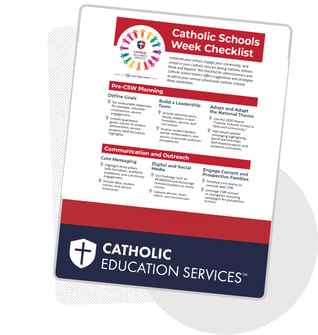
Celebrate and share your school’s mission with clarity and confidence with this checklist for leaders and administrators for Catholic Schools Week.

Here are some ways that Catholic schools can use the opportunity of Catholic Schools Week to tell their own unique story within and beyond the community. Incorporate some of these strategies and suggestions into your Catholic School Week celebrations in January.
What objectives would complement your ongoing mission: new family inquiries, prospective student tour engagement, volunteer participation, alumni involvement? Layer these with narrative goals—stories of student achievement, faculty impact, or partnerships—to capture the full breadth of your school’s contribution.
Highlight growth in student faith formation, service-learning impact, and alumni engagement alongside enrollment numbers. Using a holistic approach helps communicate to both internal and external audiences that Catholic Schools Week can be a lens into the full, unique story of your school community. Measuring success this way not only informs Catholic Schools Week planning but will also inform and strengthen year-round communications.
Consider including faculty who lead faith formation, service projects, curricular innovations, or student leadership. Student leaders, parent ambassadors, and alumni provide authentic perspectives, ensuring that your week of celebration is meaningful and resonates with your entire community. This ensures that each CSW day, whether celebrating parish, students, or families, reflects multiple perspectives and deepens engagement across the community.
Leverage the NCEA theme of “Catholic Schools: United in Faith and Community” as a flexible framework. Deepen it with school-specific storytelling: highlighting partnerships with local parishes, faith-based service projects, or academic innovation. Craft messaging that resonates with both your mission and community voice, reinforcing your school’s identity while connecting to the national celebration.
Assign each day of CSW to a purposeful focus that aligns with your ongoing mission and engagement goals:
Each day of Catholic Schools Week can reinforce your unique narrative, highlight partnerships, and complement your existing initiatives to ensure that your Catholic Schools Week celebration is an opportunity to engage.
CSW should be both aspirational and grounded in your school’s story. Highlight faith formation, academic excellence, or success stories of partnerships. Incorporate statistics, alumni stories, and service milestones to showcase impact, while emphasizing your school’s unique identity. NCEA provides multiple resources and suggestions for promotion.
Use your CSW touchpoints to integrate meaningful interactions with students, faculty, and alumni that feature your school’s unique story as a faith-filled learning community. Telling this story is a natural chance to connect with those who are interested in a Catholic education at your school.
Consider amplifying your story on social media to encourage family and student participation in creating content, such as testimonials, service highlights, and classroom showcases. High-quality, authentic visual content extends your reach and reinforces your school’s commitment to faith, learning, and service and builds a community connection around your celebration efforts.
As you plan to celebrate your school’s unique story and the value of a Catholic education, here are a few ideas to consider.
Recognize and celebrate existing families, alumni, and volunteers as integral parts of your school’s story. Share behind-the-scenes moments, invite families to participate in leadership roles, and amplify their voices campaigns. Engaged families naturally become ambassadors, supporting both retention and outreach.
Your Catholic Schools Week efforts and celebrations can last all year. Keep up your most effective efforts: family engagement, social content, volunteer participation, and stories of impact. Year-round communications, programming, and admissions strategies can continue from the momentum of this week.
Catholic Schools Week is a celebration and a chance to share your Catholic school’s unique story, reinforce mission, deepen community, and expand your reach to prospective families. By leveraging partnerships, storytelling, and thoughtful communications and initiatives, your school can ensure that this celebratory week amplifies its impact throughout the year.
%20takes%20the%20puck%20out%20of%20the%20zone%20against%20Delbarton%20during%20the%20first%20round%20of%20the%20Gordon%20Cup%20at%20the%20Ice%20Vault%20on%202_25_21_-1.png)
When Catholic school leaders think about student retention, elite student-athletes may not be the first group that comes to mind. Yet for many...

A Letter from Catholic Virtual President, Rob Birdsell

How Notre Dame High School in Sherman Oaks, California, is Strengthening Academics, Enrollment, and Student Success Through Strategic Summer and...