

A Year of Faith and Formation: Reflections on the 2025–2026 School Year
A Letter from Catholic Virtual President, Rob Birdsell
4 min read

In a globalized world, world language learning offers more than academic enrichment and becomes a strategic priority. Elementary, middle, and high school students who study additional languages gain cognitive, cultural, and career advantages that extend beyond the classroom. For Catholic schools, offering robust language programs strengthens curriculum quality, supports faith-based formation, and prepares students to thrive academically, socially, and spiritually. This article explores the benefits and suggests ways Catholic school leaders can offer more world language courses to students.
Learning a second language is powerful for cognitive development. Research shows that bilingual and multilingual individuals often demonstrate enhanced executive functions, including better attention, task switching, and problem-solving skills. Managing multiple linguistic systems exercises the brain and improves mental flexibility.
These benefits span all stages of life. Bilingual children often show greater cognitive adaptability early in life, while older adults who speak multiple languages may experience less cognitive decline, suggesting that language learning contributes to a lifelong “cognitive reserve” (Bak et al., 2011). Additionally, language study supports achievement in other academic areas, improving reading comprehension, vocabulary, and problem-solving abilities (NEA, 2026; ACTFL, 2020).
Language learners also develop enhanced multitasking abilities and mental agility. Students trained in multiple languages are better able to focus on more than one project at a time, a skill that supports classroom success across disciplines (NEA, 2026).
World language education broadens students’ cultural understanding and fosters empathy. Learning another language exposes students to diverse perspectives, customs, and traditions, helping them develop respect for human dignity and intercultural sensitivity. For Catholic schools, this aligns directly with the mission of forming compassionate, socially responsible citizens who can engage with the global community in a spirit of service and solidarity (NEA, 2026). College and Career Readiness
Language proficiency enhances students’ competitiveness in college admissions and the global workforce. Multilingual students are better prepared for careers in international business, diplomacy, healthcare, technology, and education. Colleges increasingly value applicants who demonstrate language proficiency, as it signals intellectual curiosity, cultural literacy, and adaptability.
For Catholic schools, while providing students with an education in world language an academic asset, it also supports faith formation and the mission of educating the whole child:
In short, world language learning nurtures the whole student, intellectually, socially, and spiritually, while aligning with the central mission of Catholic schools.
While it is easy to agree that world language courses are valuable to students of all ages, it can be a challenge to offer them. Many Catholic schools face challenges in staffing and resource allocation for world language programs.
Partnering with Catholic Education Services provides a practical solution.
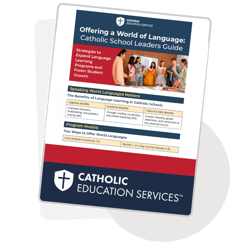
Evaluate your current world language offerings and plan your next steps with confidence using this quick, practical worksheet. Download the guide to assess student needs, identify opportunities for growth, and explore sustainable ways to expand language learning in your school.
Catholic Education Services offers flexible, high-quality online instruction in languages such as Spanish, French, German, Latin, Chinese, and American Sign Language, including both semester-length and full-year courses. Schools can offer core classes for grades K–12, including Honors and AP® levels, as well as middle school electives with story-based thematic instruction.
Catholic Education Services offers online language courses designed to meet the needs of a variety of students. Schools can choose from two flexible models:
By offering these two options—the core and elective model—Catholic Education Services allows schools to expand their language offerings for a wide range of students, providing both rigorous academic tracks and engaging elective options that fit unique school schedules and resources.
Benefits of partnership include:
World language education is essential for forming well-rounded students who are academically strong, culturally aware, and spiritually prepared. Whether as core or elective study, world language learning strengthens cognitive skills, fosters global competence, and deepens engagement with the universal Church. For Catholic school leaders, partnering with Catholic Education Services makes it feasible to expand world language programs sustainably—helping Catholic school students to thrive in school, the workforce, and the global community.
References
Bak, T. H., et al. (2011). Does bilingualism influence cognitive aging? Cerebrum. https://www.ncbi.nlm.nih.gov/pmc/articles/PMC3583091/
Burke, B. M., & Howard, E. D. (2017). Making the Case for Exploratory World Language Instruction in Catholic Elementary Schools through University Partnerships. Journal of Catholic Education, 20 (2). http://dx.doi.org/10.15365/joce.2002022017
National Education Association. (2020). The Benefits of Learning Another Language. https://www.nea.org/professional-excellence/student-engagement/tools-tips/benefits-learning-another-language
American Council on the Teaching of Foreign Languages. (2020). The Benefits of Language Learning. https://www.actfl.org/research/research-briefs/academic-benefits-of-world-language-study

A Letter from Catholic Virtual President, Rob Birdsell

How Notre Dame High School in Sherman Oaks, California, is Strengthening Academics, Enrollment, and Student Success Through Strategic Summer and...
In a globalized world, world language learning offers more than academic enrichment and becomes a strategic priority. Elementary, middle, and high...